
tl;dr
The SEC is now a force for good. TradFi’s desperate attempt at shoring up its fee base points clearly to the inescapable direction of travel for finance.
Market Snap
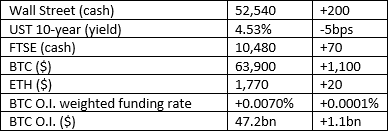
Market Wrap
Markets continue to ignore the escalation of hostilities in the Middle East, much like most of today’s newspapers.
Curious Cryptos’ Commentary – The SEC and crypto
New Chair of the SEC, Paul Atkins, a serious upgrade on the previous incumbent who aligned himself with the dark forces massing to restrict our freedom and liberty, has spearheaded a new crypto-focussed initiative
Now at the “Proposed Rule Stage”, it seems unlikely the SEC commissioners will reject this new approach to crypto assets. In a public statement, Paul explains his thinking:
“To deliver on President Trump’s goal to ensure that the United States is the crypto capital of the world, we are embracing innovation to bring more products onshore, creating clear rules of the road for capital raising with crypto assets, and providing clarity as to how market participants can custody and facilitate trading of tokenized securities onchain. All while ensuring strong investor protection guardrails are in place and continuing to pursue bad actors who violate the law.”
We have covered several significant developments around tokenisation in the last few days within these CCC missives. Paul has noticed – he wants to help facilitate the democratisation of the financial services industry to benefit us. He is probably the first regulator ever in the history of financial regulation anywhere in the world to show little inclination to bend the knee to TradFi’s intense lobbying to extend the regulatory moat at our expense.
Paul is already shaping up to be an SEC Chairman for the ages.
Curious Cryptos’ Commentary – SWIFT (no, not her) and tokenisation
The pace of innovation underpinning the tokenisation revolution shows no sign of slowing down.
SWIFT is a cooperative owned by TradFi that has served as a core cross‑border messaging and settlement infrastructure for decades. It is a vital element in providing the plumbing that allows banks to operate globally, including the repo business. It is also a key player in the battle against money laundering, financing of terrorism, and the imposition of sanctions on rogue states. I leave it to your discretion as to just how successful it is in that regard.
SWIFT has announced live pilots with seventeen global banks of a new blockchain-based ledger to “pioneer tokenised cross-border payments” on a 24/7 basis.
This development clearly shows that the TradFi industry is aware of the need to move to 24/7 settlement which is near-instantaneous incurring fees of mere fractions of cents, which on the face of it seems to a good thing. But there is a sting in the tail.
I think in this case SWIFT is acting to shore up TradFi’s dominance of the settlements industry. Its blockchain solution is private and permissioned, not public. SWIFT is effectively doubling down on the old method of using databases to store data. Private blockchains are more efficient than databases at the margin but they fail to capitalise on all the advantages of a public blockchain.
By using a private blockchain, TradFi will remain in control of the fee structure. I rather doubt the concept of fees equating to fractions of a cent is part of the roadmap, but I would be delighted if my cynicism on that point is misplaced (spoiler alert: it isn’t).
On balance, this news is supportive of the tokenisation revolution. It demonstrates that TradFi knows that tokenisation will dominate the financial services industry in its entirety. Battle lines have now been drawn between public and private blockchains. It will take a while, but there can be no doubt about the eventual winner. The sooner TradFi accepts that reality, the sooner the world becomes a materially more productive place to do business.