
tl;dr
SWIFT increasingly resembles a dinosaur. We wish USDT was one too.
Market Snap
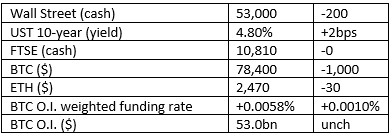
Market Wrap
That wall of short-term coins priced between $81k and $83k is proving problematic for price appreciation, for now.
Curious Cryptos’ Commentary – SWIFT
SWIFT, a core player in the settlement of cross-border payments, announced a pilot program amongst seventeen TradFi banks to trial 24/7 payment settlement on a private blockchain. SWIFT is involved in the settlement of over 50 million transactions per day servicing 11,500 financial institutions globally. It is essentially a standardised messaging service that banks use to confirm the accuracy of transfer requests. McKinsey estimates that SWIFT settles $1.2 to $1.5 QUADRILLION in value of payments a year.
But SWIFT has a major problem which is two-fold in nature. Firstly, it shuts down for weekends and bank holidays and even when it is up and running, settlement can sometimes take days. The company claims that 75% of transactions are settled within ten minutes, but I suspect that does not accord with most of its clients’ experience of the service. Even the G20 Financial Stability Board, not known for its entrepreneurship, has criticised SWIFT for being “too slow, too expensive, and too opaque”.
As we discussed back in July, SWIFT, is responding to the existential threat that near-instantaneous settlement of stablecoins at virtually no cost poses to its business model by launching its own private blockchain to facilitate and record the settlement of fiat payments. Two months in and the company is proud to announce the second successful settlement, this time between DBS and Citi timed over the weekend.
I don’t know about you, but two successful transactions in two months doesn’t sound like particularly rapid progress is being made. Neither have we been informed how many attempts have failed.
I note also that the transaction still took minutes to settle, an improvement for sure, but not a patch on the speed of transfer of US-regulated stablecoin USDC. No mention was made of the fees, but does anyone seriously think that SWIFT is going to even try to compete with the micro-cents’ costs of stablecoins? CEO of Yellow Card, Chris Maurice, has identified SWIFT’s core problem:
“Unless they're willing to change their business model and accept that the movement of money is not really something you can charge much for anymore, they're going to have a really hard time competing in the long run."
Chris is hardly unbiased as Yellow Card is a provider of stablecoin payments infrastructure, but his point remains valid, nonetheless.
SWIFT’s approach is likely destined to fail over time – its blockchain solution is private, not a public permissionless system. It will work better than a database, but it isn’t much more than that. We already know that public blockchains will become the plumbing for payment settlements, the repo business, and 24/7 trading of tokenised real-world assets. That is what is demanded by users and that is what will be provided.
…
Lest we forget, there is another source of pressure for the adoption of US regulated stablecoins for the settlement of international payments – the US government, the Fed, and the Treasury. The onshoring of $15 TRILLION or more of privately created US dollars looks much like QE from a US perspective, and QT from everyone else’s, boosting the dollar valuation of all dollar-denominated assets. Supporters of QE, and its even less progressive cousin MMT, will surely be delighted at this turn of events.
Curious Cryptos’ Commentary – Problems with USDT
USDT is the original and biggest USD-denominated stablecoin with a market cap of $183bn compared to USDC at $74bn. The latter is compliant with US regulations, the former is not, and likely never will be.
Tether, the company that issues USDT, has long sought to avoid scrutiny, a hugely irresponsible position to take given the importance of USDT to the broader crypto ecosystem.
Blockchain security firm Hacken has highlighted several cybersecurity issues with USDT, one of which is that $93bn of USDT circulating on the Tron network is secured by just two signing keys. A malicious attacker who gained control of those keys would have unlimited ability to mint as much USDT as wished, effectively pricing USDT at zero.
These problems have been compounded as S&P has recently downgraded USDT to its lowest score for stablecoin stability, for reasons that are sound. Tether has reserves that exceeds the liability to repay all the outstanding USDT by 4%. However, those reserves include nearly 6% BTC.
I hope you can see the problem – Tether has deliberately introduced correlation risk where it has no right to be. A severe correction to the price of BTC would undoubtedly lead to redemption demands of USDT. If the valuation of Tether’s reserves dropped below its liabilities, or even just the fear of that, would lead to USDT losing its peg against the dollar, causing even greater stress to the crypto ecosystem. This vicious circle is not unlike that we saw with the Luna fiasco in 2022 triggered by the unstable algorithmic stablecoin at its heart.
It is incumbent on all of us to favour using USDC over USDT.