
tl;dr
FDR’s dream of a properly functioning securities market is finally being realised. Those US Treasury buybacks at the long-end are only just getting started.
Market Snap
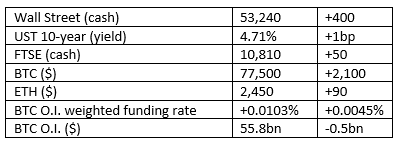
Market Wrap
The spot BTC ETFs saw net inflows of $1.9bn last week, a sharp reversal from recent months, and even more welcome for that.
Fed Chair Kevin Warsh speaks at Jackson Hole this week, potentially leading to increased volatility in rates, which may or not be beneficial to risk markets.
Curious Cryptos’ Commentary – Franklin D. Roosevelt
The Breakdown, Blockworks excellent newsletter, recently brought to everyone’s attention FDR’s musings on how to regulate securities and securities offerings:
https://www.presidency.ucsb.edu/documents/message-congress-federal-supervision-investment-securities
The core of the proposal was full and frank disclosure and “… that no essentially important element attending the issue shall be concealed from the buying public.”
One cannot argue with that, and undoubtedly securities laws across the Western world have moved – some would say too far – in that direction. But FDR also made this point:
“The purpose of the legislation I suggest is to protect the public with the least possible interference with honest business.”
The SEC and CFTC’s pivot away from the tyrannies of regulation by enforcement finally realises FDR’s dream of nine decades ago. He would be pleased.
Curious Cryptos’ Commentary – US Treasury buybacks
The latest example of market manipulation by the US Treasury was intended to reduce yield at the long end of the curve. Scott Bessent announced that the limit per-operation of debt buyback was to be increased from $2bn to $4bn. Clearly, the US government is concerned about the recent rise in the yields of 10-30-year bonds. This development can only be interpreted as a signal for further yield curve management i.e. lower yields. The issue for the Treasury is one of scale. In the context of total debt of $40tn, which has an ever-increasing servicing cost, and an annual deficit adding yet more to the debt pile, a few billion dollars here or there is insignificant.
Though the 30-year bonds rallied by 10bps or so, the biggest beneficiaries were gold and BTC, with the latter almost reaching $80k. More evidence of increased manipulation of long-term rates will fuel the rally further.
…
The question remains – absent the largest explicit money-printing operation ever contemplated (which though unlikely, should not be ruled out) where else can the US government look to provide funding for its fiscally incontinent spending plans?
USD in cash overseas is estimated at around $1tn. I always carry some dollars with me wherever I go, for they will always be accepted in exchange for goods and services anywhere in the world. The stablecoin revolution will eventually make physical dollars redundant. That $1tn will eventually make its way back to the US to be invested by stablecoin issuers who are compliant with the GENIUS Act into permitted reserve assets, including short-term US debt. But again, $1tn is still not that material.
However, at least roughly $15tn of outstanding private USD credit is owed by borrowers outside the United States, based on the BIS’s broadest standard series. These are electronic dollars created by both US and non-US banks, beyond the control of the US and of no benefit to the US.
The pace of adoption by TradFi of stablecoins will take everyone by surprise. All future creation of private USD credit will be with USD stablecoins, and that $15tn will itself be converted into USD stablecoins.
This extra demand for short-term US debt will lower short-term yields and will allow the US Treasury to dramatically and materially increase debt buyback at the long-end. From a purely US perspective this is much the same as QE – the debt buyback is funded with what are effectively newly-printed dollars. If the small increase in buybacks announced by the US Treasury last week fuelled a 21% rally in BTC, supported by the ETF flows and a short squeeze, what would several TRILLION do?