
tl;dr
TradFi banks are gearing up for the non-CBDC stablecoin revolution.
Market Snap
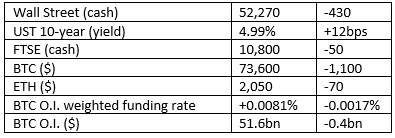
Market Wrap
CPI came in hot yesterday, raising expectations of a December rate hike instigated by the arch market-manipulators employed at the Fed.
The two key drivers of inflation – the Ukraine War and the Iran War – remain totally unaffected by any fiddling of the short or long end of the yield curve. In any case, increased energy costs are a key driver of a future economic downturn. Many more rate hikes, and the yield curve will soon invert, an inversion being the most historically accurate financial indicator of a looming recession.
Curious Cryptos’ Commentary – TradFi is moving in
Bloomberg has reported that at least four of the big beasts of TradFi are among a 21-strong group to have come together to create a jointly owned company for the purpose of issuing a dollar-denominated stablecoin.
Goldman Sachs, Citigroup, Banco Santander, and Deutsche Bank are among the backers who have committed $270mm to cover half a decade of operations at the new company, probably incorporated in the US. Its objective is to launch a GENIUS Act-compliant USD stablecoin in the first half of 2027, followed by a MiCA-compliant EUR stablecoin at some unspecified later date.
There are two things that strike me about this development.
Firstly, this is the next stage of Project Faro that was launched just over a year ago. I find it incredible that it has taken this long to get to this point. The regulatory landscape for cryptos has been made clear for a while now, despite the best intentions of Senator Elizabeth Warren and her ilk who support a “Wild West” approach to crypto regulation.
I recall that back in the day, leading TradFi firms worked very quickly on new opportunities. It seems that now the compliance restrictions are such that innovation in TradFi takes a back seat to form-filling.
Secondly, and more interestingly, TradFi firms retain the sharpest focus on their customers’ needs and wants. Instantaneous settlement, with virtually no fees, offered by a regulation-compliant stablecoin issued on a public, permissionless blockchain is the future of all finance. TradFi firms know this from their client interactions. They know that unless they can provide this service to their clients, their clients will go elsewhere.
Once TradFi gets up and running properly, the lobbying dollars to shore up a regulatory moat that diminishes the opportunity for a new disruptive competitor will start flowing freely. At which point Warren will probably execute a sharp U-turn.
Why does this matter?
The adoption of superior technology would seem to be a no-brainer. But for many firms and individuals, who rightly have no interest in the detail of the technology, confidence in using new superior tech comes from a regulatory stamp of approval, and the backing of large, trusted, public companies.
Some may scoff at the idea that big banks are still trusted by anyone, but would you hand over your life savings to a corner shop operation that promises to give it back on demand? Nah, I don’t think so. You may still retain vestiges of anger at TradFi over the Global Financial Crisis almost two decades ago. Working in the front line of the (modern-day) trenches at the time, I have long argued that the anger should be directed at the regulations that allowed the credit rating firms to abandon any pretence of independence or truthfulness.
Whatever.
When your bank starts to charge the actual costs of using current settlement systems to retail users, whilst simultaneously offering zero costs for adopters of public, permissionless blockchain-based stablecoins, I know which one you will choose.