
tl;dr
Greece, Nigeria and Switzerland: three recent examples of countries embracing crypto while the UK stands aside
Market Snap
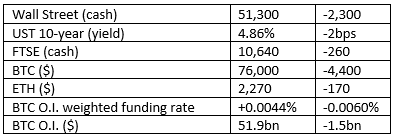
Market Wrap
The immediate post-midterms rally quickly and epically failed as AI stocks took a battering on Thursday, taking BTC with them. We have long known about the partisan approach to cryptos in the US, but I had failed to realise that this is replicated when it comes to AI. I guess I should have clocked that, for cryptos and AI are very closely linked – they both need each other to fulfil their full potential.
Nearly a billion dollars of leveraged longs got taken out. These people will never learn.
Curious Cryptos’ Commentary – Greece
The Hellenic Parliament has approved a 10% tax on crypto profits, exempted annual gains of up to €500, and provided for a twelve-month amnesty to report previously unreported gains. Tellingly, swapping one crypto for another is not a taxable event.
The Greeks are smart, and fair, in stark contrast to our overlords here in the UK.
Curious Cryptos’ Commentary – Nigeria
A Nigerian on the minimum wage earns $1.70 a day, but with 93% of employment categorised as “informal”, there are many who earn significantly less than that. The poorest 50% of the population receive just 17% of national income – those who worry about wealth inequality in the West really should take a longer look at sub-Saharan Africa. The World Bank estimates that more than half the population live in extreme poverty. For many, daily income is probably of the order of 50c.
The Nigerian diaspora, often working in physically demanding conditions, provides a desperately needed income stream for those struggling back at home. Here in Hackney, all the Nigerian barbershops offer a service to send cash back home, sometimes with painfully punitive fees attached, potentially adding up to 10% or more of the money transferred. It is no wonder that Nigeria is the dominant player within Africa for stablecoins, accounting for nearly two-thirds of the region’s inflows, for they can be transferred almost instantaneously at virtually no cost. No more rapacious middlemen is an honourable objective.
The Government of Nigeria has recognised the importance of stablecoins for the health and wealth of its population. The Central Bank of Nigeria – like all central banks, it maintains the illusion of independence though all smart people know that just ain’t true – has published new regulations for the licensing of cryptos used for payment purposes. At a weighty 169 pages, the CC team has read it on your behalf.
The new regulations have been inspired by the GENIUS Act in the US.
Collateral for stablecoins, dollar or naira, must be cash or high-quality liquid assets, in essence government bonds. Over collateralisation of at least 2% is mandated, and 20% of the reserves must be held at the central bank. Algorithmic stablecoins are explicitly banned, an approach that should be adopted globally, and in all circumstances. Issuers of stablecoins cannot pay “interest, yield, dividends, returns or other financial benefits” to holders, mirroring the result of intense lobbying by TradFi in the US to shore up its regulatory moat. Redemption is guaranteed for the next day, with no fees.
It seems that every country in the world is working hard to regulate the adoption of cryptos, except the UK, which long ago made the decision that the benefits of the crypto revolution will accrue elsewhere.
Curious Cryptos’ Commentary – Switzerland
The Swiss financial regulator, FINMA, has approved the country’s first spot BTC ETF that is available for retail investors.
Switzerland isn’t the first country to do so, but nonetheless this development breaks new ground. Normally, funds in Switzerland must spread investments over many holdings. That requirement has been waived, with FINMA citing Bitcoin’s “long trading history and a particularly high trading volume”.
Here in the UK, you can forget about accessing crypto-related ETFs. Theoretically, you can invest in crypto-related ETNs, but those come with additional counterparty risk and tracking error, and in any case many investors will fail the stringent requirements that our regulator demands of you. And in an act of petulance, crypto ETNs can no longer be held within your ISA, a deliberate move away from crypto adoption.
Why does this matter?
Why would anyone even contemplate trying to run a crypto-related business in the UK?