
tl;dr
Citi and Coinbase are doing some of the heavy lifting in support of the stablecoin revolution.
Market Snap
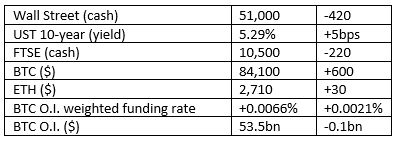
Market Wrap
The relentless rise of long-term yields shows no sign of abating. The resilience being shown in crypto prices compared with, say, stocks is impressive.
Curious Cryptos’ Commentary – Citi, Coinbase, and stablecoins
The benefits of stablecoins over fiat – at least those that are compliant with the GENIUS Act and will therefore become a regulated product in the US (spoiler alert: USDC not USDT) are obvious. Virtually instantaneous settlement at virtually no cost is the dream. This will be a massive upgrade to the legacy TradFi system largely centred on Swift, a company that increasingly resembles the dinosaur of your choosing.
Though nearly everyone agrees – notable exceptions being Putin, Xi, Kim, and Convicted Criminal Christine Lagarde – that the use of permissionless public technology is far superior to any other digital coin solution, there is one major obstacle to wholesale adoption. The traditional means of accessing and using cryptos requires self-custodial wallets whose control depends upon private keys created by a seed phrase. The security risks, and the means to mitigate those risks, are well-known. We have frequently visited that topic in these near-daily missives. Being a nerdy type, I quite enjoy that side of things, but I am acutely aware that many people are uncomfortable with such concepts.
For the diaspora of the world’s poorest and most dispossessed, the motivation for using stablecoins – i.e. saving up to 30% of the value of money transferred that can be lost in fees – will be enough to combat the self-custodial fears. In Africa, a significant proportion of retail banking already happens via apps on mobile devices. The concept of a physical bank branch is alien to many people there. Enthusiasm for adopting a crypto wallet app amongst this cohort is likely to be high.
For companies that transact domestically and internationally, the situation is somewhat different. The issue of self-custody is a much bigger barrier and, without a solution, probably an insurmountable one at that.
For institutional investors, Coinbase has long offered its Prime product, which removes the need for self-custody. The maxis don’t like it, for it proves the falsity of their oft-repeated claim “not your keys, not your coins”, which has precisely zero accuracy from a legal standpoint. Because of Prime, and its subsequent use in the spot BTC ETF industry, Coinbase is by far the largest BTC custodian in the world. There is no reason to believe that might ever change.
Coinbase has now extended its partnership with Citi to solve the custodial problems for companies that wish to offer the ability for clients to pay for goods and services with stablecoins. It is a simple and elegant solution:
For companies that have no wish to handle cryptos themselves, incoming stablecoin payments are accepted by Spring (a Citi product) and are converted to fiat by Coinbase and deposited into the relevant Citi account.
Meanwhile, companies that wish to solely or partially use stablecoins can receive fiat into Citi’s Virtual Account Wallet from which Coinbase will convert into stablecoins.
For both scenarios, the fiddly bits of handling cryptos are managed by Coinbase. guaranteeing secure custody with no risk of loss of funds. That potentially insurmountable barrier has just been robustly demolished, which can only be a good thing.
…
Why does this matter?
Encouraging the use of stablecoins throughout the global financial system will be of immeasurable benefit in improving the well-being of the world’s poorest. This is a moral imperative that naysayers wish to deny.
Shame on them.