9th July 2026
tl;dr
The implications of Robinhood Chain for TradFi and the world are profound.
Market Snap
Market Wrap
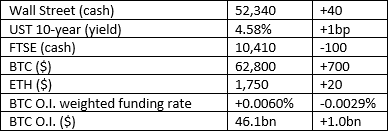
The resumption of hostilities in the Middle East is being ignored by risk markets. I think everyone now realises that this is just an ongoing situation that may be with us for years to come. Oil supply chains will adapt, perhaps leaving the world a better place than relying on the Strait of Hormuz. In any case, there has been a remarkable outbreak of sensibility amongst central bankers – a growing recognition, driven by Kevin Warsh, that raising short-term interest rates because of hikes in the oil price is self-defeating and desperately damaging. This development has the previous generation of central bankers wailing and gnashing their teeth as their previous “rock star” halo is smashed to smithereens.
Curious Cryptos’ Commentary – Robinhood Chain
Robinhood has launched Robinhood Chain on Arbitrum, an Ethereum L2 with almost instantaneous settlement and fees that amount to fractions of a cent (https://www.curiouscryptos.com/the-tokenisation-revolution/). Its purpose is to facilitate the tokenisation of real-world assets, allowing Robinhood to offer stock trading 24/7 to its retail client base.
The importance of this development must not be underestimated.
Retail clients have always been treated badly relative to institutional clients by TradFi. Access to many financial markets is denied to retail, such as pre-IPO stock offerings in tech companies which have returned thousands of percent gains for early investors including hedge funds, VCs, and prominent individuals. Bob and Joanne don’t get a look in. For a long time, retail couldn’t get broad exposure to stock indices, until Larry Fink’s brilliant and inspired creation of the ETF market when he founded BlackRock. Share trading used to be difficult and slow for retail (I still have some paper stock certificates that used to be sent to me in the post) until Charles Schwab entered the market with the first electronic platform. Even then, fees were sometimes punitive until Robinhood reinvented the retail market with zero-commission trades.
Now, for the first time ever, retail clients have access to a financial market that institutions do not – the ability to trade stocks at any time on any day. The institutions are up in arms about this. For once, retail has an advantage, and not a small one either. Robinhood Chain is a direct threat to the old-world order.
The application of blockchain technology is just the next and logical step on the road to full democratisation of the financial services industry, the third pillar of the moral imperative that underpins the blockchain revolution. For those who haven’t been paying attention, the other two pillars are the dramatic improvement in the lot of the world’s diaspora of the poor and dispossessed with the invention of phone wallets and stablecoins, and the benefits of BTC mining in driving the adoption of carbon-free electricity generation, which cannot happen without a constant force for stabilising the grid.
However, TradFi has deep pockets. Berated by institutional clients for giving retail an “unfair” advantage (in their eyes), you can be sure the response will be swift, to tilt the playing field back against retail once more.
But we can live with this. Tokenisation of stocks for institutions just became an imperative that will accelerate the tokenisation revolution. Within that revolution the seeds for complete and total democratisation of the financial services industry have already been sown.
That revolution has just accelerated, for our benefit.
…
As always with crypto, there is a trivial side to the story.
The day after the launch of Robinhood Chain, Vlad Tenev, Chairman and CEO of HOOD, had this to say:
“… memecoins are largely a dead end, assets without utility do not serve a lasting purpose”.
You may be surprised to hear that the memecoin market, though not as frothy as it once was, is still going strong. In direct response to Vlad, an unidentified creator launched an inspired memecoin:
The website is surprisingly strong for a memecoin. It includes the morally sound claim that “the cat doesn’t believe in taxes” and is based on the simple adoption of the “Cash Cat”, which was the original name for Robinhood when it first launched.
As ever with memecoins, early adopters have made out like bandits. One buyer spent $838 which has been monetised to the tune of $918k, with a remainder of coins worth $134k. A second wallet invested $85 which has been monetised to the value of $688k, with another $1.2mm in coins sitting in the wallet. The five most profitable wallets have banked nearly $4mm, which is nice work in just a few days.
These are the stories that drive the interest in memecoins, but I must point out that it is a zero-sum game. Someone’s profit is someone else’s loss. It is little different to buying lottery tickets or gambling, which I recognise are both popular pastimes for many. Greed and a lack of financial restraint support the memecoin market.
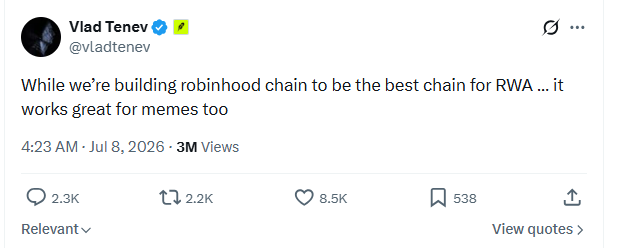
Six days after decrying memecoins as a “dead end”, Vlad noticed the traffic driven to his new blockchain by Cash Cat and declared: