
tl;dr
For the second time this year, the IMF has some positive things to say about cryptos. The wonders of the world will never cease.
Market Snap
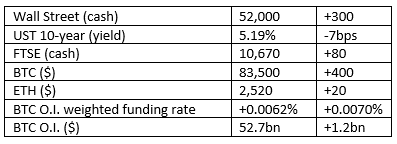
Market Wrap
Am oil tanker ablaze in the Strait of Hormuz, and a Ukrainian refinery on fire, but risk markets do not seem to care.
Curious Cryptos’ Commentary – The International Monetary Fund (IMF)
The IMF generally does not get an easy ride in the CCC. It is one of those supranational organisations that devours taxpayers’ cash (most, if not all, of its employees pay no taxes themselves, so this is a non-issue for them) for little or no useful output. Its antipathy towards cryptos in the past was all too predictable. The hegemony enjoyed by the technocratic elite is threatened by blockchain technology.
Then, an amazing thing happened. Back in April this year, the IMF issued a report that not only lacked sharp criticism of cryptos but encouraged policymakers “… to engage proactively with the structural implications of digital transformation, rather than respond reactively to its manifestations.”
Shocking, I know. But check this. It’s only gone and happened again.
This latest report looks at looks at the five most liquid tokenised US equities, including tokens tracking Tesla, Nvidia, and the S&P 500.
One of its early comments – that tokenised stock trading is less liquid than traditional stock exchanges – can hardly come as a surprise to anyone during these early days of the tokenisation revolution. That will flip one day, as the traditional exchanges are rushing to sign deals with crypto companies to launch tokenised stock trading alongside their traditional offering. It is a process, but one day, tokenised stocks will become the dominant form of trading.
There are two very interesting comments within this report.
Firstly, that 80% of trades involve less than a full share of the underlying stock. That is clearly indicative of retail participation. It shows the power that tokenisation has for the democratisation of traditional financial markets. The moats that TradFi builds around itself to the detriment of everyone else will slowly be demolished for our benefit.
The report also notes that most tokenised stock trading takes place outside of traditional stock exchange hours. The reduced liquidity of course leads to higher volatility, which can be both a blessing and a curse. The leveraged children should beware of this.
Despite reduced liquidity and higher volatility, the IMF found that when traditional stock exchanges opened again in the morning, 87% to 99% of the overnight price moves in tokenised stocks were absorbed at the open by the traditional stocks.
This is huge news that deserves to be shouted from the rooftops of all our houses.
Efficient capital markets lower the cost of capital for all businesses, increasing productivity, leading to more investment in R&D, more jobs, more pay for those jobs, and for the politicians more tax receipts. Capital markets are made more efficient by the effective transmission of pricing information to investors and decision makers.
The concept of tokenised stocks has already proved it will make capital markets more efficient. Boy, the bigwigs at the IMF must be kicking themselves in frustration that this is the outcome of their own research.
…
Why does this matter?
This is some of the clearest proof that blockchain technology is a positive force that will improve the world on many levels. We are fighting the good fight. Don’t let the naysayers get you down.