
tl;dr
The IMF has one sensible and constructive employee who is surely about to be fired this morning. Could there be a breakthrough in the logjam that is currently holding up passage of the CLARITY Act today?
Market Snap
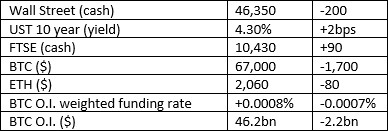
Market Wrap
BTC miners have been selling stocks of BTC recently, presumably in anticipation of higher energy prices. Mining difficulty has reduced whilst the hash rate has also dropped suggesting that some miners are turning off their rigs or repurposing them for A.I. The security and stability of the network is not at risk, but this again is a negative factor weighing on the markets in addition to Trump’s unpredictability.
Curious Cryptos’ Commentary – The IMF
The IMF – an organisation which rarely, if ever, does anything useful for humankind beyond enriching its own employees at taxpayers’ expense – has issued another crypto related report:
https://www.elibrary.imf.org/view/journals/068/2026/001/068.2026.issue-001-en.xml
Bearing in mind that institutions such as the IMF are terrified by the prospect that blockchain technology will free us plebs from the control exercised by their grubby little mitts, the opening sentences are surprisingly supportive:
“Tokenization—the representation of financial assets and liabilities on programmable digital ledgers—is increasingly shaping financial system developments. The most consequential transformation occurs within the regulated financial system, including banks, asset managers, and financial market infrastructures, where tokenization can enable atomic settlement, continuous liquidity management, and embedded compliance. This Note argues that tokenization constitutes a structural shift in financial architecture, rather than an improvement of marginal efficiency.”
I know, I had to read it a couple of times too after I had picked myself up from the floor after falling from my chair in shock. I think the brave author of this study, Tobias Adrian, is going to be hauled in front of his very angry boss this morning to be told he has lost all future hope of promotions or pay rises.
…
Much of the report is dedicated to a beginner’s description of the methodology and uses of tokenisation which is useful to have to hand. Tobias makes this important point:
“Legal uncertainty is a major barrier to scaling tokenized systems beyond pilot projects. Market participants require clarity on whether tokenized records constitute a definitive proof of ownership and whether the settlement finality achieved on a ledger is legally recognized. Without such clarity, tokenized markets risk remaining fragmented and peripheral.”
What is going on with the world when an IMF employee makes sensible and constructive comments when it comes to cryptos?
The discussion of risks rightly looks at “Financial Stability Implications” which is the obvious cue to bring up the topic of all dictators’ favourite tool of coercion and control, CBDCs, but contrary to all previous IMF-type reports it does not shout that CBDCs should replace cryptos, or that they should even exist. And look at this conclusion:
“If designed and governed appropriately, tokenization can reinforce the foundational principles of the financial system: safety, efficiency, and inclusiveness. Achieving this outcome requires policymakers to engage proactively with the structural implications of digital transformation, rather than respond reactively to its manifestations.”
Wow. Tobias really is in trouble with his boss.
Curious Cryptos’ Commentary – The CLARITY Act
Paul Grewal, chief legal officer at Coinbase, has expressed his opinion that the finishing touches will soon be applied to the CLARITY Act – “I think we’re very close to a deal” he said during an interview on Fox.
The key dispute remains on stablecoin rewards, and specifically whether stablecoin issuers can reward holders by sharing some of the proceeds from holding cash and cash-like instruments which earn yield in the traditional sense.
TradFi banks want to prevent issuers from sharing those rewards pointing to the risk of deposit flight, and claiming the playing field is skewed as they operate under a far more onerous regulatory regime than issuers of stablecoins.
Paul correctly points out that TradFi is heavily regulated because of the risks inherent in fractionalised banking, risks which have been deliberately and correctly outlawed for stablecoin issuers by the GENIUS Act passed last year.
Thrillingly Paul believes agreement would be reached within forty-eight hours of that interview which took place on Wednesday. We all do hope he is correct.