
tl;dr
The tokenisation revolution is happening right here, right now.
Market Snap
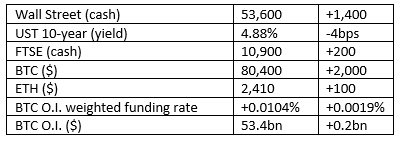
Market Wrap
Early signs are encouraging for the traditional post-midterms rally in risk assets, accompanied by a lower yield curve, the best of all worlds.
Curious Cryptos’ Commentary – Tokenisation
The Depository Trust & Clearing Corporation (DTCC) has launched, via its subsidiary The Depository Trust Company (DTC), the DTCC Tokenisation Service.
Twenty firms, mostly TradFi, such as JPMorgan (oh, the delicious irony!), Citi, Bank of America, Morgan Stanley, Fidelity, Citadel Securities, Barclays, BNP Paribas, UBS, State Street, Alpaca and DriveWealth, have signed up so far. The laggards will join soon enough.
The service allows these firms to tokenise thirty-four different stocks across two blockchains for now – Canton and DTCC’s private Besu network. The former is a public, permissionless blockchain, the latter is a private, permissioned blockchain and is therefore discounted in the opinion of the CC research team. Plans are in place to add the Stellar Network and Circle’s Arc in 2027, but they won’t be the last.
If you need to sharpen your knowledge of the tokenisation sphere, I can heartily recommend the first in our new series of “Explainers”, which breaks down for you in detail the different forms that tokenisation can take.
This new product is at the “purest” end of the tokenisation spectrum. Stocks tokenised via DTCC have the same CUSIP (the identification number) as the underlying physical stock. All the legal rights, economic entitlements, and protections that accrue to the physical stock accrue also to the tokenised stock.
Note that this is not a trading platform. Investors, whether retail or institutional, cannot simply log in to buy and sell stocks, as they can with whatever online platform they have signed up to. So what is the point you, may be asking yourself? For the participating firms, the first benefit is the ability to move securities 24/7, rather than being subject to restrictions determined by trading days and trading hours.
Of greater benefit is the ability to mobilise collateral within minutes.
The plumbing that underpins the global financial structure is the repo market, which allows for the creation of short-term loans (often overnight) collateralised by a basket of securities. Assets that would sit idle can now be used more efficiently, reducing the cost of capital for banks. In turn, a more efficient banking system lowers the cost of capital for all firms, raising productivity across the board, and making everyone wealthier. What’s not to like?
There is little publicly available information of which securities have been tokenised, and in what amounts. Canton is a privacy blockchain, and so the information that is available on more traditional blockchains, such as Bitcoin, is deliberately hidden from view. We do know that Morgan Stanley has reported that it has used the service, and Société Générale has accepted $10mm of tokenised Treasuries as collateral.
Critics will point out that there are several limitations. The scope is narrow with only thirty-four stocks, that cross-chain transfers are currently not allowed, there is only one true blockchain involved, and that there is no retail participation. Finally, issuers have pushed back against rival third-party models such as OKXICE, with over half of those targeted opting out.
All these issues are valid points of contention, but all are being addressed. Note that Alpaca and DriveWealth provide the back-end for many trading apps, so there is a clear and plausible route for retail to get involved.
Why does this matter?
This is definitive proof that major TradFi firms are embracing the tokenisation revolution, however limited in scope this project may be for now. Once operations teams become familiar with the processes involved, and senior management start seeing the real and tangible benefits of bringing down the cost of capital, adoption will accelerate, which in turn will drive product innovation.
Companies whose stocks are tokenised will see better pricing and greater liquidity in their stocks. Those resisting third party tokenisation will change their minds soon enough. I cannot help but note that JPMorgan refused permission for OKCICE to tokenise its own stock in the same week that it signed for DTCC’s tokenisation service. The lack of consistency and understanding of blockchains at senior levels of JPMorgan are laid bare once more.
DTCC has over $114 trillion of securities across all asset classes held in custody. The majority of those will be tokenised, kickstarting possibly the greatest revolution ever seen in TradFi.
Remember – none of this is possible without blockchain technology and the new crypto paradigm.