
What you'll learn
- What tokenisation is and why financial firms are adopting it
- The one question that separates every tokenised product: what do you actually own?
- The five main models, from tokens that are the asset to tokens that only track a price
- The technology, regulation and risks behind them
The basics
A blockchain is a shared digital record book. Instead of one organisation keeping the ledger in its own private database, many computers keep identical copies and follow the same rules to add new entries. Once an entry is added, it is extremely hard to change without everyone noticing.
A token is an entry in that record book saying that a particular digital wallet holds a particular quantity of something. Bitcoin and ether are tokens that represent nothing beyond themselves. Tokenisation is the process of creating a token that represents something that exists outside the blockchain, such as a share, a government bond, a fund, gold or property. These are often called real-world assets, or RWAs.
Why bother? Supporters point to four main benefits:
- Speed. Settlement (the final swap of cash for an asset) can happen in minutes rather than the one or two working days that traditional share markets need. The US moved from two days to one in May 2024, and the UK plans to do the same in October 2027 (Securities and Exchange Commission, 2024b; HM Treasury, 2025).
- Hours. Blockchains never close, so tokens can be moved at any time of day, including weekends.
- Fractions. Tokens can be split into very small units, which makes smaller holdings practical.
- Programmability. Rules such as who is allowed to hold a token, or how interest is paid, can be written into the token itself.
None of these benefits changes what the underlying asset is. That leads to the most important question in this whole subject.
The key question: what do you actually own?
Two tokens can both carry the name of the same well-known company and move in line with its share price, yet give their holders completely different legal positions. One holder may be a registered shareholder. Another may simply be owed money by a company based in Jersey or the British Virgin Islands. A third may hold a contract that pays out the price difference, with no shares involved anywhere.
The US Securities and Exchange Commission (SEC) made the same point in its January 2026 staff statement. It divides tokenised securities into those issued by, or for, the original issuer and those created by unconnected third parties. Third-party tokens are then split into "custodial" and "synthetic" forms (Securities and Exchange Commission, 2026). The format may be new, but the legal substance still decides what the holder owns.
The clearest way to understand the market is as a spectrum, running from direct ownership at one end to pure price exposure at the other (Figure 1).
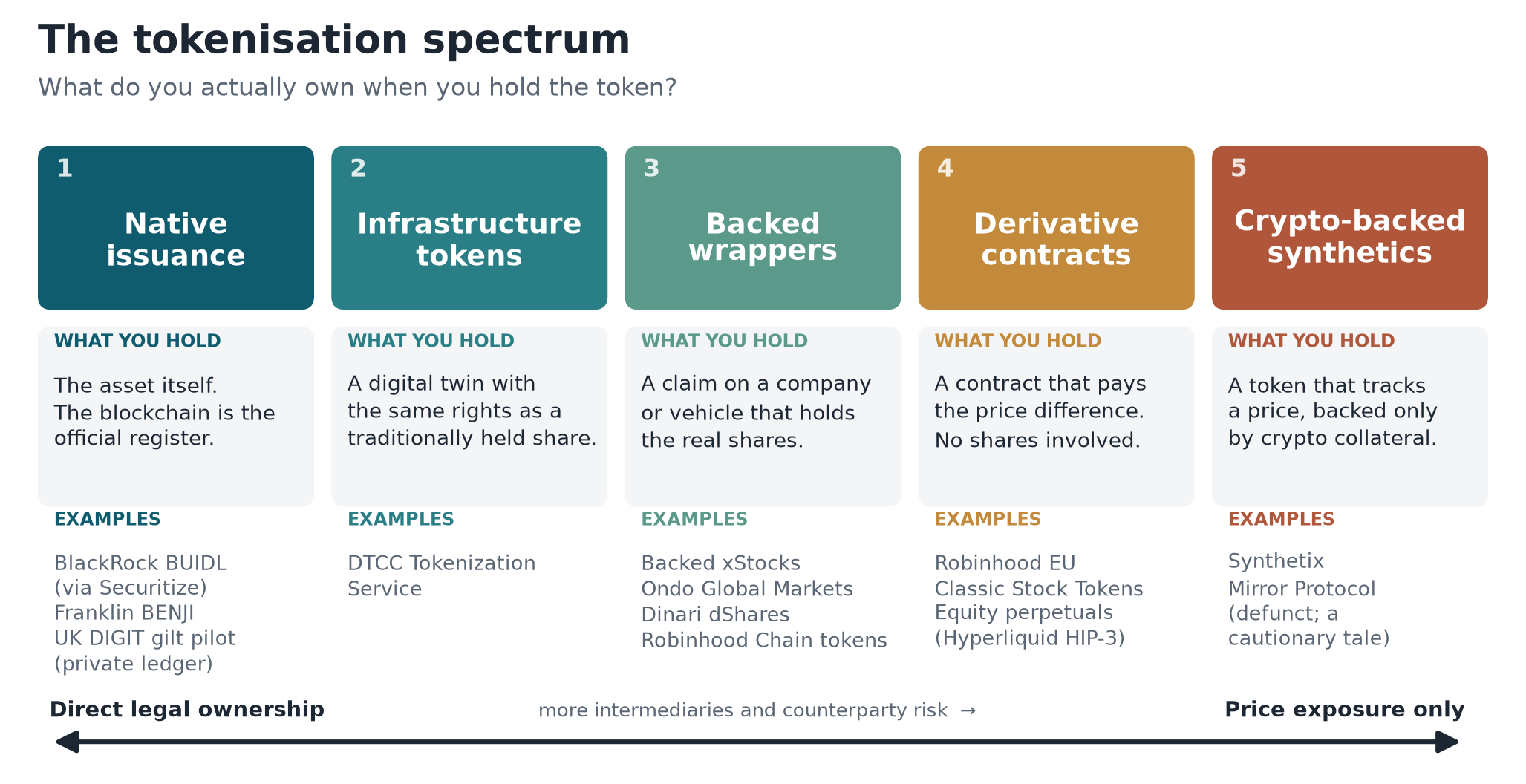
Figure 1. The tokenisation spectrum. Source: Curious Cryptos, based on the sources cited in this article.
The five models
1. Native issuance: the token is the asset
At this end of the spectrum, the blockchain is the official register of who owns the asset. When the token moves, legal ownership moves with it.
Franklin Templeton's OnChain U.S. Government Money Fund (FOBXX), whose shares are known as BENJI, launched in 2021. It was the first US-registered mutual fund to use a public blockchain as its official record of share ownership (Franklin Templeton, 2026). BlackRock's USD Institutional Digital Liquidity Fund (BUIDL) followed on Ethereum in March 2024 and was tokenised by Securitize (Securitize, 2024). Securitize operates as an SEC-registered transfer agent and broker-dealer, which means it can keep a company's official register of owners on a blockchain (Securitize, 2026a). In July 2026 it listed its own shares on the New York Stock Exchange and offered a tokenised version to eligible investors (Securitize, 2026b).
Governments are also experimenting. The UK's Digital Gilt Instrument (DIGIT) is a pilot of a short-dated, digitally native government bond, with HSBC's Orion platform chosen as the provider (HM Treasury, 2026). Orion is a private, permissioned blockchain: only approved institutions can take part, and the platform operator runs the network (HSBC, 2024). Because the ledger is private, DIGIT is not really tokenisation in the fullest sense, where tokens can be held and moved on open, public networks. It is included here because it shows that even the UK government is interested in the principle of tokenisation.
2. Infrastructure tokens: the existing system goes on-chain
Rather than every issuer building its own system, the institutions that already run financial markets can tokenise what they hold. In July 2026 the Depository Trust & Clearing Corporation (DTCC), which clears and settles virtually all broker-to-broker US share trades (DTCC, n.d.), processed live trades of tokenised "digital twins" of securities held at its depository. It said the tokens keep the same entitlements and ownership rights as their traditional equivalents, and that its Tokenization Service is scheduled to launch in October 2026 (DTCC, 2026).
3. Backed wrappers: a claim on someone who holds the asset
This is a common way for tokenised shares to reach ordinary investors outside the United States. A separate company, often a special-purpose vehicle (SPV) set up only for this job, buys real shares, holds them with a custodian, and issues tokens that track their price one-for-one.
The holder does not own the shares. Backed's xStocks, for example, are bearer debt instruments classified as tracker certificates, issued by Backed Assets (JE) Limited, a Jersey special-purpose vehicle. They do not give shareholder voting rights. Each xStock is fully backed by the matching shares, held in segregated accounts with regulated custodians. If the issuer defaults, an independent security agent may take control of those accounts, sell the shares and pass the proceeds to token holders (Backed Assets, 2026). Ondo Global Markets tokens are structured notes, a form of debt, issued by a bankruptcy-remote special-purpose vehicle in the British Virgin Islands, with holders' rights governed by Swiss law. They are not sold to US persons (Ondo Finance, n.d.a). Dinari's dShares are backed by shares held with a registered US broker-dealer (Dinari, n.d.).
Wrappers usually carry no voting rights. Dividends are generally reflected in the token's value rather than paid out (Ondo Finance, n.d.a). Buying directly from the issuer can be limited to qualified or professional investors, with everyone else trading through licensed platforms (Backed Assets, n.d.; Ondo Finance, n.d.b).
4. Derivatives: a promise, not a share
A derivative is a contract whose value is derived from something else. Robinhood's original European stock tokens, which it now calls Classic Stock Tokens, are a clear example. Legally, each one is an over-the-counter derivative contract with Robinhood Europe, UAB, a Lithuanian investment firm, regulated under the EU's MiFID II rules. Holding one does not mean owning any shares, and the contract cannot be exchanged for shares. Robinhood Europe is the only counterparty, so if it became insolvent, holders could lose their entire investment (Robinhood Europe, 2026). Robinhood says it holds the underlying assets with a US-licensed institution, but holders have no voting rights (Robinhood Europe, n.d.).
The line between models can shift. In July 2026 Robinhood launched a separate product, Stock Tokens on its own Robinhood Chain. These are tokenised debt securities issued by Robinhood Assets (Jersey) Limited. They give economic exposure to shares but no legal or beneficial rights in them (Robinhood, n.d.a). That places the newer product in the backed-wrapper category.
Crypto exchanges also offer perpetual futures, or "perps", on shares: derivatives with no expiry date that are often used with borrowed money (leverage). On Hyperliquid, for example, its HIP-3 system lets outside developers who meet a staking requirement launch their own perpetual markets. Each developer chooses the price feed and contract terms for its markets and sets the leverage limits (Hyperliquid, n.d.). Many of these markets track shares, commodities and indices.
5. Crypto-collateralised synthetics: price tracking by code
At the far end, no traditional company holds anything. Synthetix lets users lock up crypto as collateral and create "synths" whose prices follow external price feeds (Synthetix, n.d.). Mirror Protocol, built on the Terra blockchain, did the same for US shares. The SEC described its "mAssets" as security-based swaps (a type of derivative) and charged Terraform Labs and its founder, Do Kwon, with fraud (Securities and Exchange Commission, 2023). After the Terra ecosystem collapsed in May 2022, a US jury found both liable in 2024 (Securities and Exchange Commission, 2024a). The lesson is that price tracking is only as reliable as the collateral, the code and the price feeds behind it.
Comparing the models
Figure 2 shows how the chain of ownership lengthens as you move along the spectrum, and the table that follows compares the five models side by side.
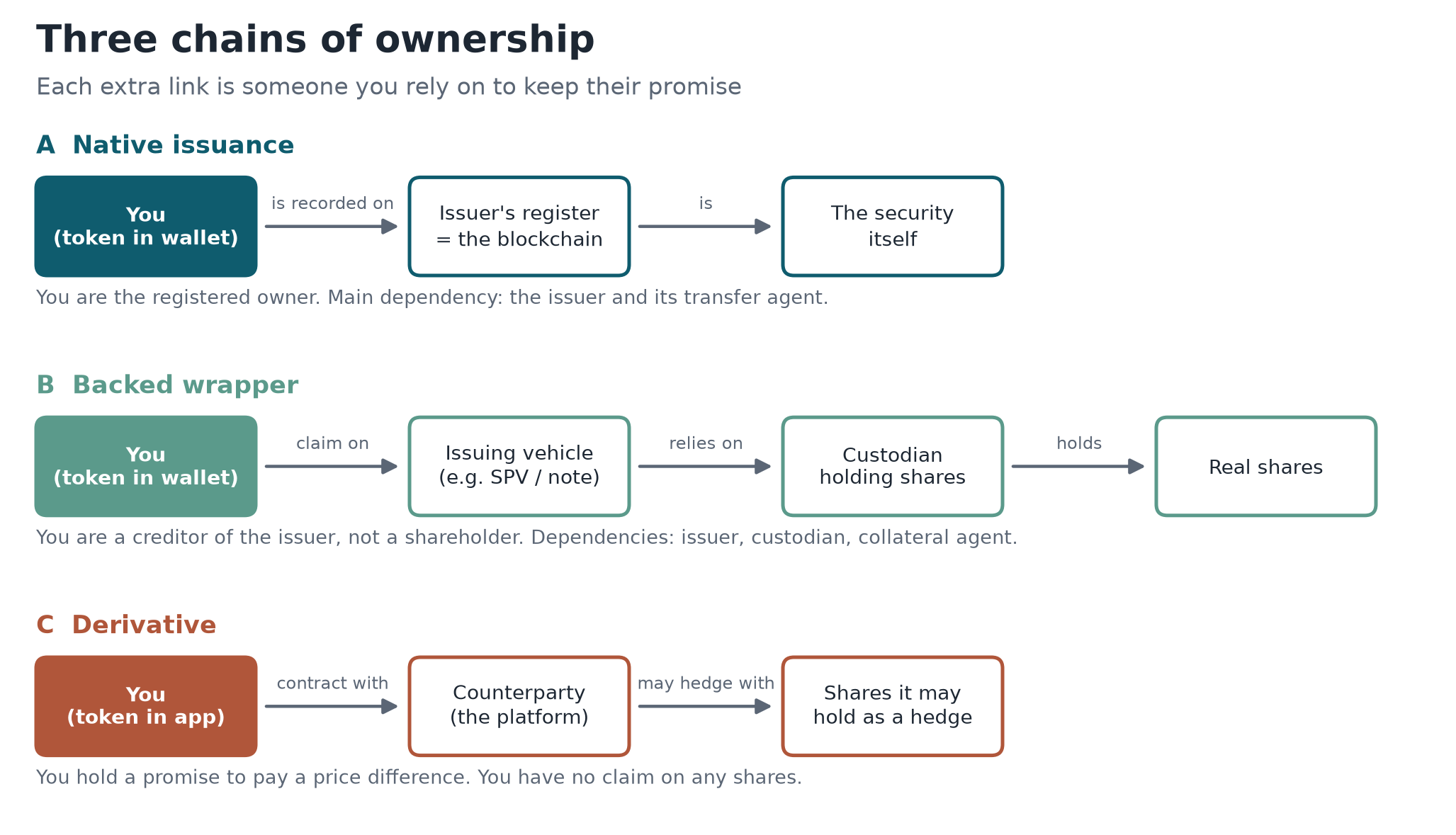
Figure 2. Chains of ownership for native, wrapped and derivative tokens. Source: Curious Cryptos.
| Model | Do you own the asset? | Voting and dividends | Who you depend on | Who can buy |
|---|---|---|---|---|
| Native | Yes | Usually yes | Issuer and transfer agent | Often verified or professional investors |
| Infrastructure | Yes, as today | Yes | Market infrastructure | Institutions |
| Backed wrapper | No: you are a creditor of the issuer | Rarely; dividends often reinvested | Issuer, custodian, collateral agent | Varies by country |
| Derivative | No | No voting; dividend amounts may be passed on | The platform | Platform customers |
| Synthetic | No | No | Smart contracts, collateral, price feeds | Anyone with a wallet |
The technology underneath
Tokenised assets run on a range of blockchains. BUIDL launched on Ethereum (Securitize, 2024). BENJI uses Stellar, among other networks (Franklin Templeton, 2026). Robinhood Chain is built with Arbitrum technology on top of Ethereum (Robinhood, n.d.b), and JPMorgan's deposit token runs on Base (J.P. Morgan, 2025). DTCC's service uses its own private network alongside Canton (DTCC, 2026), a public blockchain with built-in privacy designed for financial institutions (Canton Network, n.d.). Tokens usually follow shared technical standards. ERC-20 is the basic token format on Ethereum and compatible networks (Vogelsteller and Buterin, 2015). ERC-3643 adds identity checks so that only approved wallets can hold a token (ERC-3643 Association, n.d.). Because blockchains cannot see prices in the outside world, oracles feed that data in. Chainlink, for example, gathers asset prices from many sources and publishes them on-chain (Chainlink, n.d.).
Rules and regulation
Regulators broadly agree on one principle: putting an asset on a blockchain does not change what it legally is (Securities and Exchange Commission, 2026). In the EU, the DLT Pilot Regime lets approved firms test trading and settlement of tokenised shares, bonds and funds under set limits (ESMA, n.d.). The EU's separate crypto-asset regulation, MiCA, does not cover crypto-assets that count as financial instruments (European Union, 2023). In the UK, the Digital Securities Sandbox, run by the Bank of England and the Financial Conduct Authority, allows live testing and is due to run until December 2028 (Financial Conduct Authority, 2026). Tokenised cash, such as bank deposit tokens, is a related development (J.P. Morgan, 2025).
Risks and open questions
- Counterparty risk. Every extra link in the chain is someone who must stay solvent and honest.
- Access and redemption. Being able to trade a token does not always mean being able to exchange it for the real asset.
- Price gaps. Tokens that trade at weekends can drift from share prices set on exchanges that are closed.
- Technology risk. Code errors, oracle failures and lost wallet keys have no equivalent in traditional finance.
- Legal uncertainty. Insolvency law and cross-border rules for these structures are still being tested.
Market snapshot (October 2026)
These figures change quickly and will be updated at each review.
- Tokenised US Treasuries: about $14.7bn in distributed value, according to RWA.xyz, an independent tracker of on-chain data (RWA.xyz, 2026)
- Securitize: total assets under management of $4.3bn at 30 June 2026 (Securitize, 2026c)
- DTCC Tokenization Service: commercial launch scheduled for October 2026 (DTCC, 2026)
Glossary
- Counterparty: the other party to a contract, whom you rely on to pay.
- Custodian: a regulated firm that holds assets safely for others.
- Oracle: a service that feeds real-world data, such as prices, onto a blockchain.
- Special-purpose vehicle (SPV): a company set up for one narrow purpose, often to keep assets separate from a parent company's other risks.
- Transfer agent: the firm that keeps the official register of who owns a security.
Important: This article is for educational purposes only. It is not financial, investment, legal or tax advice. Naming a company, protocol or product does not mean we endorse or recommend it. Many products described here are not available in every country or to every type of investor.
References
Backed Assets (n.d.) ASML xStock: product page. Available at: https://assets.backed.fi/products/asml-xstock (Accessed: 1 October 2026).
Backed Assets (2026) Product legal overview. xStocks documentation. Available at: https://docs.xstocks.fi/docs/product-legal-overview (Accessed: 1 October 2026).
Canton Network (n.d.) Canton Network overview. Canton Network Docs. Available at: https://docs.canton.network/integrations/wallets-and-exchanges/canton-network-overview (Accessed: 1 October 2026).
Chainlink (n.d.) Chainlink data feeds. Chainlink documentation. Available at: https://docs.chain.link/data-feeds (Accessed: 1 October 2026).
Dinari (n.d.) dShares. Available at: https://dinari.com/dshares (Accessed: 28 September 2026).
DTCC (n.d.) Clearing & settlement services. Available at: https://www.dtcc.com/en/clearing-and-settlement-services (Accessed: 1 October 2026).
DTCC (2026) DTC-tokenized assets power successful U.S. trades. Press release, 15 July. Available at: https://www.dtcc.com/press-releases/2026/dtcc-turns-tokenization-into-reality (Accessed: 28 September 2026).
ERC-3643 Association (n.d.) ERC-3643 documentation. Available at: https://docs.erc3643.org/erc-3643 (Accessed: 28 September 2026).
ESMA (n.d.) DLT Pilot Regime. European Securities and Markets Authority. Available at: https://www.esma.europa.eu/esmas-activities/digital-finance-and-innovation/dlt-pilot-regime (Accessed: 28 September 2026).
European Union (2023) Regulation (EU) 2023/1114 of the European Parliament and of the Council of 31 May 2023 on markets in crypto-assets. Official Journal of the European Union, L 150, 9 June. Available at: https://eur-lex.europa.eu/eli/reg/2023/1114/oj/eng (Accessed: 1 October 2026).
Financial Conduct Authority (2026) Digital Securities Sandbox. Available at: https://www.fca.org.uk/firms/innovation/digital-securities-sandbox (Accessed: 28 September 2026).
Franklin Templeton (2026) Franklin Templeton and Stellar Development Foundation mark five years of Benji. Press release, 30 April. Available at: https://www.franklintempleton.com/press-releases/news-room/2026/franklin-templeton-stellar-development-foundation-mark-five-years-of-benji-the-first-u.s.-registered-tokenized-money-market-fund (Accessed: 28 September 2026).
HM Treasury (2025) Accelerated settlement (T+1). GOV.UK. Available at: https://www.gov.uk/government/publications/accelerated-settlement-t1 (Accessed: 1 October 2026).
HM Treasury (2026) Update on the Digital Gilt Instrument (DIGIT) pilot issuance. GOV.UK. Available at: https://www.gov.uk/government/publications/update-on-the-digital-gilt-instrument-digit-pilot-issuance/update-on-the-digital-gilt-instrument-digit-pilot-issuance (Accessed: 28 September 2026).
HSBC (2024) HSBC delivers world's first multi-currency digital bond offering. HSBC Global Banking and Markets, 16 February. Available at: https://www.business.hsbc.com/en-gb/insights/first-multi-currency-digital-bond-offering (Accessed: 1 October 2026).
Hyperliquid (n.d.) HIP-3: builder-deployed perpetuals. Hyperliquid Docs. Available at: https://hyperliquid.gitbook.io/hyperliquid-docs/hyperliquid-improvement-proposals-hips/hip-3-builder-deployed-perpetuals (Accessed: 1 October 2026).
J.P. Morgan (2025) Kinexys by J.P. Morgan launches USD deposit token (JPMD) on Base. Available at: https://www.jpmorgan.com/payments/newsroom/kinexys-usd-digital-deposit-tokens (Accessed: 28 September 2026).
Ondo Finance (n.d.a) Ondo Stocks: legal & regulatory. Available at: https://docs.ondo.finance/ondo-stocks/legal-and-regulatory (Accessed: 1 October 2026).
Ondo Finance (n.d.b) Disclaimers. Available at: https://docs.ondo.finance/legal/disclaimers (Accessed: 1 October 2026).
Robinhood (n.d.a) Stock Tokens. Robinhood Chain documentation. Available at: https://docs.robinhood.com/chain/stock-tokens/ (Accessed: 1 October 2026).
Robinhood (n.d.b) About Robinhood Chain. Robinhood Chain documentation. Available at: https://docs.robinhood.com/chain/ (Accessed: 1 October 2026).
Robinhood Europe (n.d.) Classic Stock Tokens FAQ. Available at: https://robinhood.com/eu/en/support/articles/stock-tokens-faq/ (Accessed: 1 October 2026).
Robinhood Europe (2026) Key information document: US-listed share / ETP derivative. Robinhood Europe, UAB, 1 July. Available at: https://cdn.robinhood.com/assets/robinhood/legal/stock_tokens_kid_eu.pdf (Accessed: 1 October 2026).
RWA.xyz (2026) Tokenized Treasuries. Available at: https://app.rwa.xyz/treasuries (Accessed: 28 September 2026).
Securities and Exchange Commission (2023) SEC charges Terraform and CEO Do Kwon with defrauding investors in crypto schemes. Press release 2023-32, 16 February. Available at: https://www.sec.gov/newsroom/press-releases/2023-32 (Accessed: 1 October 2026).
Securities and Exchange Commission (2024a) Terraform and Kwon to pay $4.5 billion following fraud verdict. Press release 2024-73, 13 June. Available at: https://www.sec.gov/newsroom/press-releases/2024-73 (Accessed: 1 October 2026).
Securities and Exchange Commission (2024b) New "T+1" settlement cycle: what investors need to know. Investor.gov investor bulletin, 27 March. Available at: https://www.investor.gov/introduction-investing/general-resources/news-alerts/alerts-bulletins/investor-bulletins/new-t1-settlement-cycle-what-investors-need-know-investor-bulletin (Accessed: 1 October 2026).
Securities and Exchange Commission (2026) Statement on tokenized securities. Divisions of Corporation Finance, Investment Management, and Trading and Markets, 28 January. Available at: https://www.sec.gov/newsroom/speeches-statements/corp-fin-statement-tokenized-securities-012826-statement-tokenized-securities (Accessed: 28 September 2026).
Securitize (2024) BlackRock launches its first tokenized fund, BUIDL, on the Ethereum network. Press release, 20 March. Available at: https://investors.securitize.io/news/news-details/2024/BlackRock-Launches-Its-First-Tokenized-Fund-BUIDL-on-the-Ethereum-Network-03-20-2024/default.aspx (Accessed: 1 October 2026).
Securitize (2026a) Securitize completes business combination with Cantor Equity Partners II. Available at: https://investors.securitize.io/news/news-details/2026/Securitize-Completes-Business-Combination-with-Cantor-Equity-Partners-II/default.aspx (Accessed: 28 September 2026).
Securitize (2026b) Tokenizing SECZ: Securitize brings its own public stock onchain at listing day. Available at: https://investors.securitize.io/news/news-details/2026/Tokenizing-SECZ-Securitize-Brings-Its-Own-Public-Stock-Onchain-at-Listing-Day/default.aspx (Accessed: 28 September 2026).
Securitize (2026c) Securitize reports second quarter 2026 results. Press release, 12 August. Available at: https://investors.securitize.io/news/news-details/2026/Securitize-Reports-Second-Quarter-2026-Results/default.aspx (Accessed: 1 October 2026).
Synthetix (n.d.) Synthetix user documentation. Available at: https://docs.synthetix.io/user-docs/v2-user-docs (Accessed: 28 September 2026).
Vogelsteller, F. and Buterin, V. (2015) EIP-20: Token standard. Ethereum Improvement Proposals. Available at: https://eips.ethereum.org/EIPS/eip-20 (Accessed: 1 October 2026).
Version history
1.4 (October 2026): Clarified that HSBC Orion, the platform for the UK DIGIT pilot, is a private blockchain.
1.1 to 1.3 (October 2026): All references moved to primary sources, and citations added for previously uncited facts.
1.0 (September 2026): First publication.