
tl;dr
The combined quantum computing/AI risk is an opportunity for BTC, not the threat that everyone else assumes it to be.
Market Snap
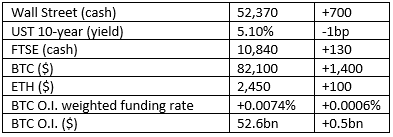
Market Wrap
A brief dip yesterday afternoon to $79.8k was met with a wall of buyers creating a rapid rebound to reclaim $82k within the hour. That suggests a resilient base of dip-buyers which bodes well going into year-end.
Curious Cryptos’ Commentary – It’s an opportunity, not a threat
Much has been made of the idea that advances in quantum computing technology put the encryption at the heart of BTC at risk. In essence, it is believed that a sufficiently powerful quantum computer could derive a private key from a public key. This is just theory for now, but quantum computing tech experts are probably not just spreading FUD.
The CCC has long made the point that if BTC’s encryption is at risk, the problem is much more widespread than just that. Elliptic Curve Digital Signature Algorithm (ECDSA) is used in areas far beyond just cryptos – website security, remote logins, software updates, and internet infrastructure. Many aspects of your digital existence would be made vulnerable by a computer that can crack ECDSA – your fiat bank account, your health records, your private emails, the vast amounts of non-publicly available information that organisations hold about all of us, amongst many other issues. However, it seems to me, and maybe this is more of a reflection of the crypto bubble I live in, that the crypto community is far noisier about it than anyone else.
The CCC also recently reported that fears have been raised that perhaps AI can do the job of cracking ECDSA long before a quantum computer. Again, the only people seemingly bothered are those in the crypto community.
And this is why the quantum/AI risk is an opportunity, not a threat.
You may or may not be familiar with BIPs – Bitcoin Improvement Protocols. These are proposed changes to the BTC code created by anyone who wishes to do so. If it meets formatting and clarity rules, it is assigned a number which triggers debate amongst the BTC community, and the development of test code. If enough miners signal their intent to accept the new code, it gets added to node software such as Bitcoin Core, resulting in a soft-fork.
BIP-360 (Pay-to-Merkel Root, or P2MR) was published in February 2026. This explicitly keeps public keys hidden until the coins are spent. BIP-361 sets out a path to move away from today’s signatures, and the potential for freezing coins that are not moved, notably the Satoshi stash. Coinbase, which as custodian to most of the spot BTC ETFs and many institutions and therefore has custody (not ownership) of 5% of all BTC, has weighed in on the side of BIP-360.
The point is that a lot of work is going on to address these potential issues. I have a lot of faith that we will soon see a solution that is accepted by all, ahead of TradFi, or the health system, or your email provider completing their own migrations.
Charles Edwards of Capriole Investments, in an interview with Bitcoin Magazine, agrees with me. In the chapter about quantum risk (14:50 into the video), Charles makes the following statement:
“If they kind of align and say, okay, this is the roadmap that we’re going to do, or this is the signature schemes that we’re going to probably implement in the next sort of 12 months or 18 months or what have you, I think that results in a significant repricing of Bitcoin up.”
He puts the repricing at 30 – 50% higher potentially in a single day. I think he understates the case, but you would expect me to say that.
…
Why does this matter?
There is no doubt in my mind that cryptos will solve the quantum/AI risk to encryption long before anyone else. It will be a small source of solace that our crypto bags stay safe whilst the rest of the world burns around us.