
tl;dr
AI is potentially a bigger threat than quantum computers to our encrypted lives, a topic far, far greater than just cryptos. But that is what we focus on in the CCC.
Market Snap
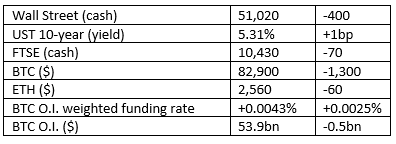
Market Wrap
Yesterday’s 10-year intraday yield of 5.36% was the highest for twenty-four years, driven by stories of Trump’s renewed interest in bombing Iran. I do look forward to the day when the Market Wrap no longer must include the word “Iran” on an almost daily basis.
Curious Cryptos’ Commentary – OpenAI and maths
OpenAI has posted 722 mathematical transcripts, including hundreds of solutions to open problems, which it claims were created from a single prompt to a new AI model that has not yet been released:
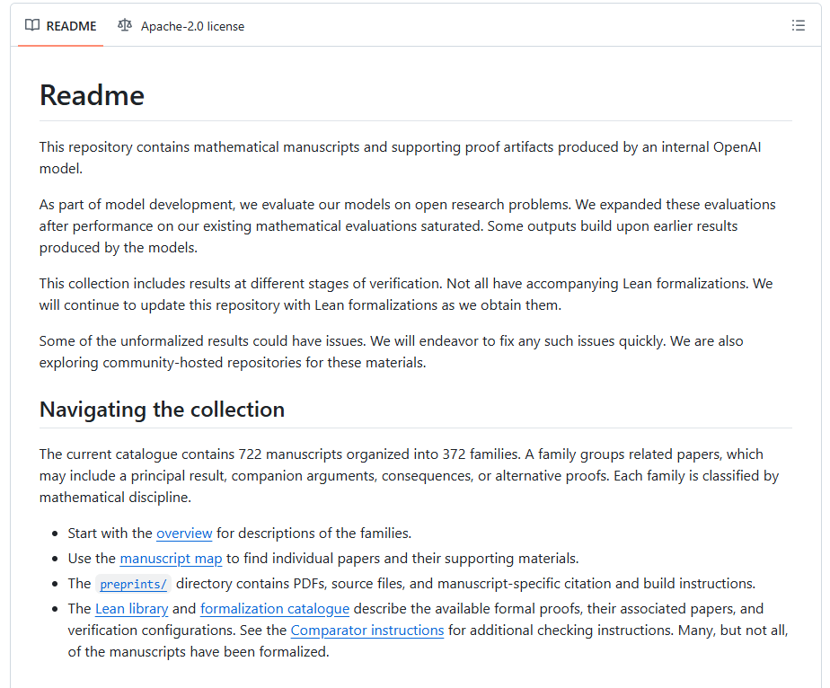
Source: https://github.com/openai/math
There is a lot of debate, and there are many questions about quite how revolutionary these results are. Here at CC Towers, we are not qualified to comment on that debate, but it has raised a concern expressed by Ethereum researcher Justin Drake who has claimed that “mathematical superintelligence is upon us”.
That may or may not be true, but it is always wise to be cautious. Justin has raised the prospect that the Elliptic Curve Digital Signature Algorithm (ECDSA) could be broken by AI long before so-called “q-day” when quantum computers become reliable and powerful enough to break ECDSA. Justin believes that AI might be able to do it in months, which I admit is a scary sounding prospect. ECDSA is used in areas far beyond just cryptos - in website security, remote logins, software updates, and internet infrastructure. A malicious attacker could cause carnage to almost every aspect of modern-day life.
There is little I can do about protecting your fiat bank account, your health records, your private emails, the vast amounts of non-publicly available information that organisations hold about all of us, amongst other issues. However, there is a simple solution for your crypto stash, so that is what will concern us today.
…
The key risk is a relatively simple one to explain, and relatively simple to mitigate.
Any wallet which has sent cryptos to another wallet has exposed its public key on the blockchain. Any wallet that has received funds using P2PK (Pay to public key) has its public key exposed on the blockchain. These wallets are potentially at risk from AI reverse engineering the private key from the public key allowing an attacker to spend the funds held in that wallet.
The solution is to hold funds in a wallet which has not previously disbursed any funds and received its funds using P2PKH (Pay to public key hash) or P2WPKH (Native Segwit) for which the public key has been hashed before being recorded on the blockchain and is therefore not visible.
This is very simple in principle, but as always with cryptos, there are wrinkles. Today, we will look specifically at BTC, ETH, and all ERC-20 tokens. BTC and ETH account for 70% of the total market capitalisation of all cryptos, whilst ERC-20 tokens take that up to an estimated 84%. Later this month, the CCC will publish a much more detailed guide that will cover 95% or more of the total value of all cryptos.
…
Assuming you hold your BTC in a self-custodial wallet secured by a Ledger Nano, using Native Segwit (addresses start with bc1q), then the public key is only ever exposed when you send BTC from that address. Ledger Live generates a new address each time you receive BTC, and each time you spend BTC. Any change is automatically sent to a new address, derived from your seed phrase but with a new private key. So, if, like most sensible and rational people, you have only ever been accumulating BTC over a long period of time, say a decade or more, it is likely your BTC stash is safe. However, to be completely sure of that, generate a new receive address in Ledger Live and send your entire balance to that new address. A small transaction fee in the 10s of cents is a small price to pay to ensure your public key has not been exposed.
If you do not use a Ledger Nano, you will have to wait for our detailed guide to be published later in October. But don’t panic – this AI risk is either months or more likely years away. But now is the time to start planning your defence.
For ETH and ERC-20 tokens, open a new ETH wallet within Ledger Live, transfer all the ERC-20 tokens to that wallet first, and then your ETH. For now, those funds will be safe. The problem becomes live again as and when any of your sell targets for those ERC-20 tokens are triggered and you therefore move some to either a CEX or a DEX. That will expose the public key once more, requiring you to move everything again.
I have a few ideas about how to manage that problem though I have no concrete recommendation today. Again, you will have to wait for that detailed guide mentioned above.
…
Why does this matter?
On a couple of levels, the first one being that you should want to make your crypto stash safe from both AI and quantum computers.
Once you have done that, you need to assess for yourself what the AI risk means for the crypto revolution going forward. For me, it will be a temporary hiccup that results in a huge overreaction in the pricing of cryptos, offering the very best buying opportunity of all time. If you do not see it that way, and I understand why you might not, then you really should end your crypto investing journey today. Not financial advice, just my honest opinion.