
tl;dr
A sorry tale of woe and despair, with catastrophe narrowly avoided, for now at least.
Market Snap
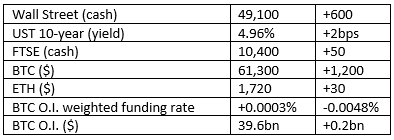
Market Wrap
Three Asian countries announced plans to support their stock markets before today’s open:
“Korea prepared its stock stabilization fund, which has not been used since 2008. Taiwan banned short selling below the previous close across all listed stocks. China cut margin requirements and trading fees. Coordinated weekend measures like these usually mean policymakers are worried about the open.”
Source: 10xResearch
If we start to see co-ordinated government interference in stock markets globally, the Santa Claus rally is back in play.
Curious Cryptos’ Commentary – BTCS
Pure-play DATCos run a simple business model. They issue shares to buy, say, BTC when those shares are trading at a premium to the underlying asset. This was the process initially used by Strategy, supported by its legacy software business, which presumably funded ongoing administrative and other costs. Strategy got greedy and started issuing preference shares with high coupons of 8% to 12%. The problem in doing so is obvious enough. Strategy has been furiously buying back its STRC preferred shares when it can. Investors will be glad to see the back of them, one day.
BTCS is a DATCo with a twist. It raises money to buy ETH which it then stakes, providing a steady stream of income. It also has a business line optimising transaction ordering, known as MEV, or maximal extractable value, a morally dubious activity which strips value away from ordinary investors’ DeFi and other activities.
If that wasn’t enough, BTCS also deploys ETH, stablecoins, and other crypto assets into decentralised-finance (DeFi) protocols, including lending and liquidity provision, to juice its returns. This introduces leverage into BTCS’ crypto operations, which no sensible people would ever commit to.
Curious Cryptos recently reported that BTCS faced potential liquidation of a large part of its ETH holdings that had been pledged on Aave in exchange for USDT and GHO, which BTCS says were mainly used to fund liquidity-pool positions through its Imperium DeFi business. On the 13th of November, with ETH at $1,950, the liquidation price was estimated to be just above $1,700. That did not look comfortable to me.
ETH did drop to just under $1,540. However, BTCS has somehow managed to pay off $10mm of its then current debt of $64mm, giving a new liquidation price estimated to be just under $1,450, assuming its collateral is unchanged. This current rally in the crypto markets generally has the executives at BTCS looking skyward in appreciation following several sleepless and sweaty nights.
In response to questions regarding BTCS’ viability regarding its Aave exposure, the company filed the following information:
- Aave debt of $54mm.
- Outstanding senior secured convertible notes of $18mm.
- Value of crypto assets $111mm (when ETH was at $1,775).
The Board had capped borrowing at 50% of the market value of its crypto assets. With a current market cap of $35mm, a quick and dirty calculation suggests the shares are underpriced by 10% or so though the value of ETH has fallen since the filing.
Why does this matter?
Reputable sources claim that daily ETH volumes traded are around $9bn or so. An influx of $50mm sell orders if ETH traded down to the BTCS liquidation price would be easily absorbed, with no discernible impact on pricing from a liquidity perspective.
However, the reputational risk is greater. A forced unwind of 50% of its crypto assets would make for some gruesome headlines, which would undoubtedly impact the entire DATCo sector, and would likely lead to a decline in the price of ETH, through sentiment alone.
It is always at times of maximum market stress that leverage plays get unwound, further exacerbating that stress. The only upside to a forced liquidation of BTCS’ assets would be the short-lived appearance of some bargain basement buys of other DATCos.