
tl;dr
BTC once again proves its value in the cause of net zero. There are some very smart central bankers in Asia.
Market Snap
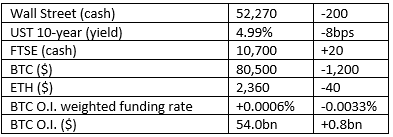
Market Wrap
It’s a sea of redness for the large market cap coins as the price of oil returns to the March highs we saw following Trump’s bombing of Iran on February 28th, just as I landed in Dubai on my way home from Sri Lanka. A week or more spent in a warzone really wasn’t that much fun for someone as cowardly as me. Life is all about timing.
AI-related stocks continue to slide. Open Interest in perpetual futures is rising, whilst the weighted funding rate threatens a short squeeze on any positive macro news.
There is a well-established correlation between the performance of risk assets and the lead-up to the midterms. Post the midterms has traditionally been a time of rich pickings for stock investors, but the expected ramp-up in hostilities after November 3rd might be of more import this time around.
Curious Cryptos’ Commentary – You have got to get one of these
For anyone in the US or Canada with a hot water tank powered by electricity, Heatbit has launched a new product, Bitwater.
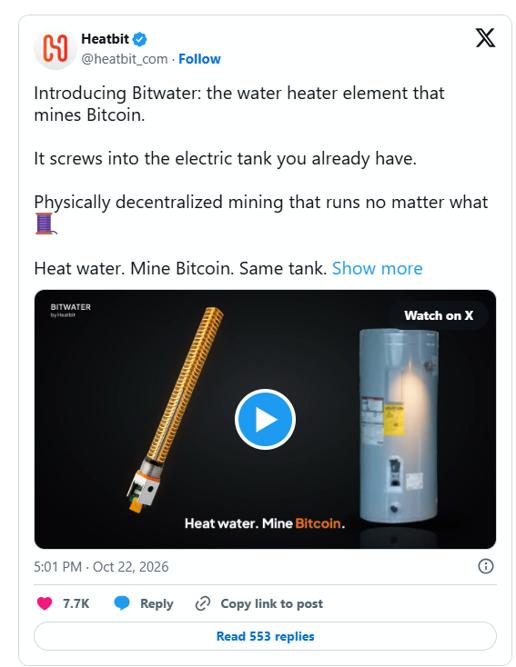
This remarkable little device replaces the current heating element in your hot water tank with one that contains twenty BTC mining chips:
“Same heat, same electricity, plus bitcoin … the electricity was going to be spent on hot water anyway.”
No fans, no noise, and essentially free BTC, which is something we all enjoy. Apparently, it is a simple DIY job (I am sure I can get it badly wrong). Like all home-style miners, you can mine solo or join a pool. The former offers the possibility, however rare, of earning 3.125 BTC plus fees (approximately $250k) for successfully adding a block to the chain. The latter pools your hashrate with others, providing a reliable and quantifiable income stream of around $500 per year paid in BTC. If your personal prediction for BTC is a price of $1.25mm (and few could argue with that), then if you simply accumulate BTC from your hot water tank you can think of it as being $8,000 per year of capital accumulation. You will have to pay capital gains tax when you do finally sell, but that will be a nice problem to have in ten years’ time.
Heatbit estimates that homes worldwide use around 300 terawatt-hours of electricity a year heating water, compared with around 170 terawatt-hours for BTC mining.
Time to ditch the old gas combi-boiler, I think, and use solar for hot water and BTC. Once again, we see the tremendous benefit that BTC mining offers the world when it comes to the adoption of renewables.
Curious Cryptos’ Commentary – Singapore, Malaysia, and Thailand
You wouldn’t know it if you live in the Western world, but there are some central banks out there that do add value to people’s lives.
Singapore’s central bank began the BLOOM initiative (Borderless, Liquid, Open, Online, Multi-currency) last October. Its objective is to explore how cross-border payments will work when stablecoins become the dominant form of money transfer, and tokenised real-world assets become the dominant form of securities ownership.
The Monetary Authority of Singapore has announced that the central banks of Malaysia and Thailand have joined the initiative as policymaker members.
Leong Sing Chiong, Deputy Managing Director (Markets and Development), MAS, explains:
“The future of finance will involve multiple forms of digital money operating across different institutions and markets. To fully harness the benefits of using digital money, collaboration among policymakers and industry participants will be needed to address practical issues around acceptance, settlement and interoperability. We welcome the contributions from Bank Negara Malaysia and Bank of Thailand as we work together to support more seamless cross-border financial transactions.”
It is important to recognise that the direction of travel is to use public, permissionless blockchains as opposed to the much inferior option of private, permissioned blockchains. We know this because one of the participants in the initiative is Ripple, which is testing trade payments using RLUSD (Ripple’s own stablecoin) on the XRP Ledger.
Other participants include Visa, Mastercard, Circle, and Coinbase, all of whom have long recognised the future for the settlements industry. JPMorgan is also involved, adding further evidence that the bank has started to accept that the moats it tried to erect around its own permissioned distributed ledger technology are of no interest to the rest of the world.
…
Why does this matter?
The countries that ready themselves to embrace both the stablecoin and the tokenisation revolution from a legislative/regulatory standpoint will be the first to reap the productivity-enhancing benefits offered by blockchain technology. Those countries that ignore cryptos, the most egregious example of which for a decade or more now is the UK, will suffer long and hard.