
tl;dr
Mastercard is attempting to clean up TradFi and about time too. JPMorgan capitulates in recognition that decentralised ledgers are superior to anything it could build itself.
Market Snap
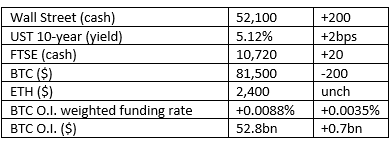
Market Wrap
Over half a yard of inflows ($527mm to be exact) into the spot BTC ETFs yesterday is a good start to the week.
Curious Cryptos’ Commentary – Mastercard and Stablecoin Security
Mastercard has announced the launch of Stablecoin Security in partnership with Borderless.xyz and Keyrails.
This initiative uses the transparency of public blockchains to help “… financial institutions identify fraud, scams, sanctions and other financial-crime risk indicators throughout the stablecoin payment lifecycle”.
Ann Johnson, executive vice president, Security Solutions at Mastercard, explains:
“Stablecoins are creating new possibilities for value exchange, but financial institutions need the right intelligence and controls to participate with confidence. By bringing payment and blockchain insights together, Stablecoin Security extends Mastercard’s fraud and risk capabilities to digital asset payments, giving institutions a clearer view of risk to make more informed decisions and build greater trust.”
Delivered as an API, it generates a risk score before a payment is completed, for every payment. It checks links to potential fraud, scams, violation of sanctions, and all other forms of financial crime risk. This risk score feeds directly into existing compliance systems within banks, as an additional check to the current process. It has the potential to revolutionise TradFi compliance with the law.
…
Why does this matter?
During the twenty-five years I spent working in the City on various credit trading desks, we were constantly reminded of our responsibilities with respect to potential money-laundering offences. We would have regular training, and I was in frequent contact with Compliance. The administrative systems were robust. It is inconceivable to me that there is any money-laundering except when it is being wilfully undertaken.
Which it is, on a regular basis. To take an example at random, Bank of America has just been fined more than $1.21bn by the US Treasury, including a $750mm OCC penalty, the largest in OCC’s history. Its crime? The bank failed to report more than $5bn of suspicious transactions in time. Over $1bn of these were linked to Chinese money-laundering networks which I believe ultimately serve the interests of tyrannical Xi and his murderous henchmen.
Or take TD Bank, which was fined $3.09bn in 2024 after the bank as an entity pleaded guilty to conspiracy to launder money. Some branch staff have been jailed, but no executives have been charged. The Chief Executive, Bharat Masrani, retired, Chief Compliance Officer Monica Kowal resigned, followed shortly afterwards by the head of the anti-money laundering office, Herb Mazariego, who was brought in to clean up TD’s operations. No-one at Bank of America has taken personal responsibility for its failings and no-one has faced censure of any sort, as far as is publicly known.
Regular readers already know that dollar-denominated stablecoins will replace the current global settlements system based on the Swift messaging service. TradFi banks are lobbying hard to delay the stablecoin revolution as it threatens both legitimate and illegitimate revenue streams. Stablecoins offer the promise of a world in which the ability of drug dealers, terrorists, and feral scammers to operate is hindered to a degree that is not possible today with TradFi.
This is another moral crusade for the crypto industry, and it is another significant blow to the credibility of the naysayers.
Curious Cryptos’ Commentary – And whilst we are on the subject of naysayers
JPMorgan’s CEO Jamie Dimon was one of the most vocal naysayers, working in concert with people like Warren Buffett, Elizabeth Warren, and Gary Gensler, a smorgasbord of villains to the crypto community. Dimon famously claimed that no-one could be sure that only 21mm BTC would ever be mined, an illustration of just how poorly informed he used to be.
The bank launched its own coin, JPM Coin, which represents dollar deposits held at the bank on its own private, permissioned blockchain known as Kinexys. Permissioned blockchains are no more than glorified databases that fail to provide the benefits of public, permissionless blockchains.
Having realised that mistake, the bank made JPM Coin available on Base and is now deployed on Ethereum. Emma Landriault, Global Head of Kinexys Labs, said:
“Issuing JPM Coin first on Base and now on Ethereum is a meaningful step towards providing our institutional clients with multi-chain optionality for moving wholesale money across both the web3 and traditional finance ecosystems.”
JPMorgan’s embrace of the tokenisation revolution on public blockchains is a significant indicator of just how deeply embedded cryptos will become in the financial system.