
tl;dr
SoFi Technologies and SoFi Bank illuminate the way forward for the banking industry.
Market Snap
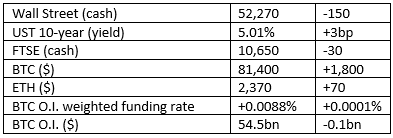
Market Wrap
Microsoft and Alphabet report later today, with Amazon and Intel tomorrow, potentially exacerbating or ameliorating the recent AI sell-off. The Fed will manipulate interest rates again later today, a practice that will one day be deemed unconscionable. Is BTC being front-run ahead of the midterms?
Curious Cryptos’ Commentary – SoFi Technologies and SoFi Bank
SoFi Bank – a subsidiary of SoFi Technologies – is an OCC-regulated, FDIC-insured depository institution. It is a FinTech bank challenging the hegemony of TradFi. The regulatory moats designed to protect the large banks at the expense of the individual are slowly being dismantled by cryptos for everyone’s benefit.
Last December, SoFi launched its own stablecoin, SoFiUSD, compliant with the GENIUS Act, on Ethereum. It claimed, with some justification, that this was the first example of a stablecoin issued by a national bank on a public, permissionless blockchain.
SoFiUSD was aimed initially at banks, fintechs, and platforms looking for near-instantaneous settlement at fractional-cent costs 24/7, an offering that no sane business would ever turn down. SoFi CEO Anthony Noto explains:
“Blockchain is a technology super cycle that will fundamentally change finance, not just in payments, but across every area of money”.
But regular readers already know that.
SoFiUSD is being rolled out to settle SoFi’s Mastercard transactions onchain for its retail clients. Its entire card program is in the process of migrating onchain, a bold initiative that again has first-mover advantage. Annualised volumes are initially expected to exceed $25bn. The functionality is being offered to third parties who may choose to use SoFiUSD or create a white-label stablecoin using SoFi Bank as the custodian of the collateral. If successful, that $25bn is a tiny fraction of what annual volumes will become.
For merchants who take payment using Mastercard, there is no impact on their existing payment systems. Mastercard Global Head of Digital Commercialization Sherri Haymond sets out the vision:
“Stablecoins become meaningful when they solve real problems that businesses face every day. With SoFi, we're moving beyond exploration to implementation, bringing regulated stablecoin settlement into a live production environment while preserving the trust, scale and safeguards expected from Mastercard. This is another step toward giving businesses more choice in how money moves.”
SoFi has also been offering a cryptocurrency trading platform to its clients since November 2025, after the OCC clarified in March 2026 that banks like SoFi have regulatory approval to do so.
It has launched FDIC-insured tokenised deposits, currently earning 4.4% APY, that can be instantly exchanged for either fiat or SoFiUSD. You won’t get that service from your traditional money-market fund held in your online brokerage account.
A partnership with Kraken extends SoFi’s settlement network deep into the traditional crypto space.
In all, the third quarter results released yesterday were accompanied by the astonishing claim SoFi has 503,000 crypto accounts. The results reported that gross crypto transaction revenue is up 20% from the prior quarter, demonstrating that its clients are increasingly using its crypto products.
Gosh, these are exciting times we are living through.
…
Why does this matter?
We have talked a lot about the stablecoin revolution, and this is just one more example of the process that is underway to move virtually all dollar settlements onchain, backed by GENIUS compliant stablecoins, near instantaneously for costs that are fractions of a cent at any time you wish.
But there is more to it than just that.
The regulatory clarity that GENIUS has provided is leading to an explosion of innovation in the use of cryptos in the banking system. Adoption is ever-increasing to the benefit of both the providers and individual investors. Within five years, the banking landscape will have changed out of all recognition, and we will have cryptos to thank for that.