
tl;dr
Some bad news which we really could do without.
Market Snap
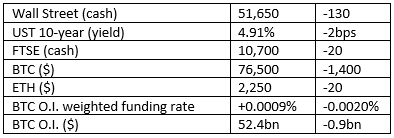
Market Wrap
The Binance hack has caused over a billion dollars to flee the spot BTC ETFs in just two days, exerting downward price pressure. I am always surprised at how much hot money seems to flow into and out of the ETFs. Losing the speculators is no bad thing.
Occasional Series
You have yet another chance to see me make a fool of myself on stage, this time as Daisy the (walking, talking, singing, and dancing) Cow in Jack and the Walthamstow Beanstalk.
I have always thought that artistic integrity is overrated.
Curious Cryptos’ Commentary – Not again
Whilst markets digest the enormous $6.3bn hack of Binance, Brazil’s largest exchange, Mercado Bitcoin, has halted withdrawals following a $40mm hack early yesterday morning, apparently across at least ten different blockchains, including Bitcoin, Ethereum, Solana, and Tron.
The means of attack has not yet been disclosed.
The receiving wallet addresses have been published to allow the crypto community to track the movement of funds. More than $9mm of USDT has been frozen by Tether, preventing the hackers from accessing those funds, but, of course, everyone else too.
There is much debate about Tether’s and Circle’s ability to freeze funds. Bitcoin maxis don’t like it because there is a degree of centralisation which one must admit does run contrary to Satoshi Nakamoto’s original vision. Law enforcement agencies, and all reasonable people, welcome it.
But in the case of USDT, Tether isn’t doing this for the greater good. If the senior executives of that company were on the side of the crypto revolution, as opposed to simply coining it big-style, they would rapidly re-engineer their business model to be compliant with the GENIUS Act. But they refuse to do so for USDT, raising the risk of a run on USDT one day in the future. That could be quite disastrous.
The reason Tether is keen on freezing USDT is that the frozen coins can sit locked until such a time as Tether, at its discretion, decides whether to burn them, and reissue them to victims or law enforcement. Tether claims a total of $1.2bn has been returned over the years. Meanwhile, the assets behind those coins provide an income stream for Tether. That, I believe, is the motivation for freezing USDT that has been hacked. There is nothing altruistic about that.
Curious Cryptos’ Commentary – Not again, again
Let’s get it all out of the way at once.
On Sunday, BTCPay Server reported that older versions of the software were being attacked, with the hackers draining some hot wallets:
"We are receiving reports of hot wallets on BTCPay Servers being swept by unauthorized attackers. If you're running an instance, please shut it down (./btcpay-down.sh) until we complete the investigation."
Last Thursday, an updated version was released to fix some a critical vulnerability and dozens of lesser ones identified by Anthropic's AI scanner, though the attack exploited an older flaw, which had been patched in August, on servers that had not been updated.
BTCPay is self-hosted, so it is up to users to ensure they stay on top of any updates. Total losses are yet to be quantified but estimates are ranging between $1mm and $2mm.
Why does this matter?
Every time we have incidents like this, the security and reputation of cryptos take a hit. Even I can see that. There is an interesting dichotomy that hacks are usually derived from some element of centralisation, but the whole industry is moving in that direction with the regulatory developments and increasing adoption for use in TradFi. Given that there will always be feral scumbag hackers around, this is an ongoing issue.
The one positive is that the bottom of the cycle is always marked by a succession of bad news events. That doesn’t mean we won’t get more, but the tide is due to turn, though please recognise that this is not investment advice.