
tl;dr
A brief look at the crypto views of the man nominated to be the new President of the ECB.
Market Snap
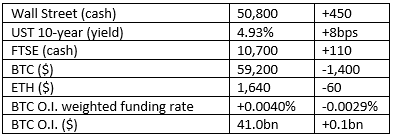
Market Wrap
The flight out of spot BTC ETFs shows no signs of abating. Daily outflows measured in the hundreds of millions are putting downward pressure on the price of BTC.
Curious Cryptos’ Commentary – The ECB
Following Christine Lagarde's announcement that she will step down as President of the ECB on 7 February 2027, the European Council has nominated Pablo Hernández de Cos, a former Bank of Spain Governor, to succeed her.
Lagarde’s anti-crypto stance has been well publicised, both by herself and by the CCC. Her unwavering support for a Euro CBDC is telling:
The ECB is institutionally anti-crypto. The reams of research fluff that come out of it stretches credulity to breaking point. I am all for a healthy debate on all matters, but increasingly it seems that the larger an institution becomes, the more embedded is the groupthink. The failure to understand that alternative points of view are healthy can only lead to sub-optimal decision making.
So, what of the new guy? Will anything change?
De Cos was chairman of the Basel Committee on Banking Supervision from 2019 to 2024. This organisation is responsible for determining capital requirements for banks. The core idea is a sensible one – riskier assets need more capital to be set against them than less risky assets. But immediately you can see the problem. A bunch of bureaucrats sitting in plush Swiss offices, counting their tax-free salaries and benefits that dwarf anything that normal people could dream of earning, may lack the knowledge and judgement skills required.
This is made apparent in the Basel rules that allow highly rated government debt, and in the EU all member-state debt, to be treated as risk-free. Greek government bonds were investment grade before the Global Financial Crisis. Investors who lost 50% or more on those bonds probably wouldn’t agree with the claim they were risk-free.
Buyers of long-dated UK government bonds a few years ago are now sitting on losses as high as 75% of notional for the 0.5% 2061 gilt. How is that risk-free?
During his time on the committee, de Cos oversaw the introduction of a risk weighting of an extraordinary 1,250% to be held against any crypto assets that regulated banks held on their balance sheets. Essentially, this rule prevented banks from owning cryptos.
I am not going to debate whether that is the right decision or not. But it does give us great insight into de Cos’ likely attitude towards cryptos.
Whilst serving on the Governing Council of the ECB, de Cos was a strong supporter of Lagarde’s enthusiasm for a Euro CBDC. That is no surprise – he would never have been elevated to that position if he opposed Lagarde’s view.
Recently, de Cos expressed his belief that stablecoins are not a credible means of payment on a large scale. He is going to be surprised when he finds out in a few short years that public, permissionless dollar stablecoins account for most cross-border settlements.
He did make the relevant point that widespread use of dollar stablecoins might undermine individual countries’ control of monetary policy. That much is obvious – the countries that have adopted the US dollar as their currency have ceded all responsibility to the Fed.
However, his response does not address that issue; rather it skirts around the problem. He would like to see a world of tokenised bank deposits running on private, permissioned blockchains owned by TradFi, interacting with CBDCs. Good luck with that, mate.
Why does this matter?
The ECB’s scope to hold back the crypto revolution is hampered by the EU’s crypto regulations, MiCA (Markets in Crypto Assets). With MiCA, the global gold standard for crypto regulation, embedded in the EU’s regulatory system, de Cos’ hands are somewhat tied.
But if anyone had even the smallest hope that the changing of the guard at the ECB might influence its institutional antagonism towards cryptos, then give it up. That will likely never happen in our lifetimes.