
tl;dr
No surprise the CLARITY Act failed to pass cloture. Another signpost for the direction of travel for tokenisation.
Market Snap
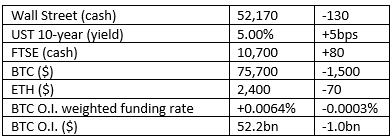
Market Wrap
The failure of the CLARITY Act yesterday to pass cloture in the Senate hurt cryptos a little, but had a bigger impact on crypto-related stocks such as Coinbase Inc. and Circle Inc. Today, the Fed gets to manipulate interest rates once more. Though with long-end yields at multi-decade highs there really is no need for the Fed to increase the probability of a global economic downturn.
Curious Cryptos’ Commentary – The CLARITY Act
Yesterday, the Senate voted 49-50 against invoking cloture for the CLARITY Act, falling very short of the 60 votes required. Split mostly along partisan lines (though four Republicans voted against) this turn of events comes as no surprise to regular readers of the CCC – it has been destined to fail for months now – a prediction frequently shared in these missives.
There are two key issues for those who voted against the CLARITY Act. The first is undoubtedly valid, and that concerns the Trump family’s crypto-related ventures, specifically the rather murky setup regarding World Liberty Financial which we covered here and here. Though several “ethics” provisions have been put forward with the agreement of the White House, it is hard to see how this bridge could ever be crossed.
The second concern regarding payment of interest-like rewards for holding stablecoins is frankly bollocks, to use a technical term. The large TradFi banks have lobbied very successfully to protect their cheap funding sourced via deposits. The CLARITY Act, as proposed, did put some limitations on stablecoin rewards, but the big banks do not want to concede any ground at all. They are very successful in promoting overly onerous legislation that shores up the regulatory moat that hinders any new competition.
The subsequent sell-off in cryptos and crypto-related stocks means that the market wasn’t fully pricing such an obvious outcome, which is a surprise to me.
After the vote failed, the finger-pointing in comments made to the press by all sides was distasteful, and destructive for any hope of future bipartisan agreement. The hoped-for de-politicisation of cryptos in the US has taken a significant turn for the worse.
There are some claiming that there is still legislative time to revisit this vote but that seems very unlikely to me. In any case, it would likely fail again. With Polymarket pricing Democratic control of the House at 88% and of the Senate at 59% after the November midterms, the CLARITY Act really is dead and buried for the foreseeable future. The naysayers are delighted with themselves, though they know not what they have lost as a result.
Curious Cryptos’ Commentary – Tokenisation
An interesting fact – Nasdaq has invested $100mm into centralised cryptocurrency exchange Kraken, which recently began issuing tokenised stocks via xStocks. We will soon see the day when most of the time that you use your investment app to buy or sell stocks, those trades will be tokenised stocks routed on a public permissionless blockchain. Most investors won’t even know that is happening. They will know that the costs of investing have mysteriously reduced with measurable benefits to capital markets, lowering the cost of capital for businesses, and increasing productivity.
Not in the UK of course.
We are being deliberately difficult in the adoption of blockchain technology. In any case, the stamp duty paid when buying shares of UK-incorporated companies only is designed to make investing in UK business more expensive hence reducing returns to risk takers and making capital markets less efficient. This damages UK businesses’ ability and appetite to invest and grow. Our motivation for doing so escapes me, for a more productive, larger economy leads to a higher tax base, which is all that politicians are really interested in. Sensible countries such as the US, Canada, Germany, Japan, and Australia have no truck with such a growth-damaging policy.