
2nd July 2026
tl;dr
The UK takes a giant stride forward in the battle to win crypto tax dollars. Binance is in trouble again.
Market Snap
Market Wrap
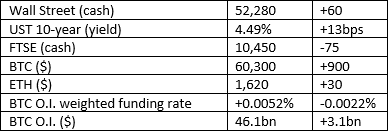
Outflows from the spot BTC ETFs continue apace with $2.4bn over the last six trading days and $4.5bn in June. For the whole of 2026 there is now a net outflow, not something I would ever have predicted. BTC’s price is remarkably resilient in the face of this rotation out of BTC and into AI related stocks.
Curious Cryptos’ Commentary – The UK
The UK regulator, the Financial Conduct Authority or FCA, has published its regulatory framework for cryptos:
Scheduled to come into force from September 2027, firms can apply for authorisation with the FCA from 30th September this year. Executive director of payments and digital finance at the FCA, David Geale, explains:
“This is a significant moment for crypto regulation in the UK. We’ve created a framework that doesn’t force firms to choose between regulatory certainty and room to innovate – this regime means they can have both in a stable, competitive home to build and grow.”
That’s a bold claim from one the most risk-averse regulators in the entire world, a claim that needs testing.
…
Established financial services standards around the issues of consumer protection, governance, and market integrity now apply equally to the crypto markets. That is clearly a sensible move, and one that should have been made years ago. We should be pleased that the FCA has finally got around to making at least one sensible decision.
Stablecoins get their own set of rules and regulations, which is clearly a good thing:
https://www.fca.org.uk/publication/policy/ps26-10.pdf
The key requirements concern the collateral for a stablecoin which must be denominated in the same currency. There is to be a minimum of 5% on-demand deposit i.e. cash, with the remainder in cash-like equivalents, essentially money-market funds which are highly liquid and whose market value deviates only a small amount from the notional.
The collateral must be held in a statutory trust ring fencing those assets from any clam by general creditors to the issuing entity, with fiduciary duties imposed on the trustee.
I note also that TradFi has clearly been hard at work lobbying the FCA as stablecoin issuers will not be allowed to pass any interest income onto holders. This is the same issue as the one holding up progress on passing the CLARITY Act in the US. TradFi is scared witless by the prospect of losing access to very cheap money in the form of rip-off retail deposit accounts. Rather than take on the competitive threat, the banks want to continue to make excess profits by shoring up their regulatory moat, predatory and uncompetitive behaviour that should be called out.
Another key section concerns “Regulated Cryptoasset Activities”:
https://www.fca.org.uk/publication/policy/ps26-11.pdf
These requirements are largely reflective of current practice but tailored for the crypto world. Issues such as staking are covered, and there is a carve-out for pure decentralised protocols, which is a remarkably sensible approach.
It looks like David meant what he said – the crypto industry now has a very clear set of regulatory guidelines in the UK, which is as surprising as it is exciting.
I feel duty bound to write some words that I never expected to - well done FCA!
Curious Cryptos’ Commentary – Binance and the UK
Binance’s track record when it comes to compliance is sketchy at best but can fairly be described as deliberately antagonistic. This attitude has been rewarded with a failure to gain a MiCA license forcing Binance to cease operations throughout the EU.
The platform is still available in the UK. I would hope that Binance executives are furiously reading the new UK rules and have already started work on the application to be registered in the UK. However, both Binance and founder man-child Changpeng Zhao are being sued by investors for offering derivatives products to UK investors after the FCA had banned Binance from doing so in 2021. The plaintiffs are seeking £150mm in compensation.
Binance are clearly in breach of the rules in place at the time, but these investors are not blameless. It wasn’t a secret that crypto derivatives were – and remain – banned in the UK. It is clear to everyone that using leverage to trade cryptos is almost invariably going to lead to large losses. Anyone who thinks differently probably doesn’t understand what they are doing.
Losing access to Binance spot-markets in the UK would leave a gaping hole in the crypto landscape for retail investors. Let us hope that does not come to pass.