
tl;dr
A brief foray into the varied world of spot crypto ETFs.
Market Snap
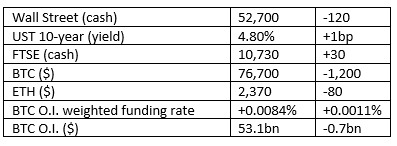
Market Wrap
What happens when US 10-year yields exceed 5% with the mid-terms looming?
Curious Cryptos’ Commentary – Spot crypto ETFs
The CCC has almost entirely focused on spot BTC ETFs in the past and largely ignored the expanding universe of other cryptos which have their own ETF vehicle. It might be time to revisit that balance.
Starting with BTC, cumulative net flows into the spot ETFs is quoted at $54.7bn by Farside Investors. This represents a not insignificant portion of about 3.5% of the total market capitalisation of BTC at $1.55tn. Personally, I am surprised it isn’t higher. There is a small annual fee of the order of tens of basis points for holding BTC in an ETF but the advantages of doing so are legion:
i) No self-custody risk.
ii) No centralised cryptocurrency exchange counterparty risk.
iii) The ETF shares can be traded in your normal online brokerage account with ample liquidity.
iv) Tax declarations are included in your annual brokerage report which is shared with the taxman removing the risk of inadvertent mistakes.
v) The possibility of holding the ETF in a tax-free investment account. If you share the CCC’s view of BTC’s long-term price trajectory, this advantage should not be overlooked.
The problem for those of us in the UK is that our financial regulator, the FCA, does not recognise US-based spot ETFs as a valid investment. This is one of those regulatory decisions made whilst the hapless Andrew Bailey was head of the FCA, before failing upwards into his current role as Governor of the Bank of England.
We do have access to some spot BTC ETPs (exchange-traded products) but these carry credit risk to the issuing counterparty, the performance tracks derivatives of BTC in most cases, not BTC itself, and the bid-offers can be daunting at times.
If this situation changes, the CCC Treasury will move some of its current BTC holdings currently held at a secure third-party location requiring multisig into the ETF. It might be a long wait.
There is a lot of (pay-walled) research which shows correlation between ETF flows and BTC’s price. There is some more limited research which suggests causation. Inflows tend to precede gains in the market price. Outflows tend to follow significant downward price movements.
This makes sense I believe. Committed investors will use lower prices to accumulate BTC more favourably than otherwise. Speculative money reacts emotionally to short-term losses with panic selling.
…
Since the US made listing standards for spot crypto ETFs generic, there has been an ever-expanding universe of products to choose from.
ETH was the second coin to benefit from the launch of spot ETFs. Farside data shows total net inflows of $13.1bn. Though this figure is significantly lower than the equivalent for BTC, it represents a higher percentage of total market capitalisation at 4.5%.
There has been an impressive 13-day streak of inflows to spot ETH ETFs for a total of $1.6bn which compares favourably to the BTC inflows of $2.3bn over that period. Many ETH ETFs benefit from an income stream created by staking though most investors fail to recognise that a portion of those rewards comes from an inflation in the issuance of ETH. All other things being equal (which they never are) an increase in the issuance will lead to an equivalent decrease in the coin price to maintain the market capitalisation. It is also fair to point out that the remainder of the staking rewards are fees paid by the users of ETH which does represent true income comparable to dividend yields or interest paid on cash deposits.
Other ETFs include XRP and SOL which appear to be gaining in popularity. There are some more niche ones such as HYPE, LINK, BNB, and DOGE, all coins that have long been held in the CC Treasury portfolio.
The additional benefit of a range of spot ETFs for both retail and institutional investors, is the ability to devise a broad portfolio of coins which can be easily tracked in performance terms within your brokerage account, and which can be quickly adjusted to reflect any underperformance or outperformance. This flexibility is not to be underestimated when compared to the time taken to move coins out of cold storage, onto a centralised or decentralised platform to swap, and then to move coins back into cold storage. Ease of investment makes those investments far more attractive.
…
I feel duty-bound at this stage to repeat once again one of my bugbears. If you know this already, feel free to go and do something more useful instead.
The crypto press often makes statements like this:
“Goldman Sachs, Jane Street Group, and Millennium Management were the three largest reported holders of spot XRP ETFs in second-quarter 13F filings, according to Bloomberg Intelligence data shared by James Seyffart on August 31.
The filings show that institutional exposure has grown alongside a sharp increase in XRP ETF inflows, even as the Ripple token itself has pulled back from its August highs.”
That comes from an article by CryptoPotato dated today.
It is nonsense.
Those three investment managers are holding the ETFs on behalf of their clients, retail and institutional. They do not themselves invest in the spot crypto ETFs.
The ETF marketing desk will continually hedge its customer flows initially using futures. The OTC broking desk matches buyers and sellers. It rarely holds inventory of any material amount itself, which would in any case be hedged, probably using futures. Old-style prop desks don’t really exist anymore outside of hedge funds.
I do worry sometimes about the lack of financial knowledge, experience, and expertise, demonstrated by many, if not most, crypto commentators.