
tl;dr
The US, in the absence of the CLARITY Act, is cracking on with regulating stablecoins under the GENIUS Act, and a good thing it is too.
Market Snap
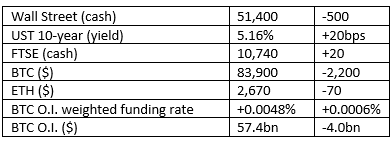
Market Wrap
Six consecutive days of inflows to the spot BTC ETFs totalling $2.5bn is a positive backdrop for BTC though long-end yields are providing a significant obstacle for many risk assets.
Occasional Series – We love Andy Burnham, we do
Andy Burnham, the UK’s Prime Minister (for now at least, as we chop and change more frequently than Italy) has said that it is unfair for football fans to be discriminated against compared to other sports spectators by the ban on drinking alcohol whilst in sight of the pitch.
At long last, we have a leader in the UK with a sensible, grown-up issue to address that we can all unite behind.
Curious Cryptos’ Commentary – The Fed and the GENIUS Act
The GENIUS Act mandated that the regulators and the Treasury Department put in place regulations by July 2026. Slightly delayed, the Fed has opened a sixty-day consultation period for “… two proposals related to establishing a regulatory framework for Board-supervised payment stablecoin issuers under the GENIUS Act.”
I assume the delay was because of the expectation that progress would be made regarding the CLARITY Act, which would have become the primary legislation for the issuance and use of stablecoins. In the absence of CLARITY, these two proposals signpost the way forward for stablecoins in the US.
The first proposal relates to the capital and reserve requirements that underpin a stablecoin. Fed Governor Michael Barr explains:
“Stablecoins will only be stable if they can be reliably and promptly redeemed at par in a range of conditions. This includes during market stress, when pressure can be put on the value of even otherwise liquid government debt, and during episodes of strain on the individual issuer or its related entities.”
The proposal makes the collateral requirement plain:
“Under the proposal, reserve assets must be segregated from other assets of the Board-supervised PPSI and must include only cash in U.S. dollars, Federal Reserve Bank balances, deposits or insured shares payable upon demand at an insured depository institution, Treasuries with a remaining maturity of 93 days or less, money received under overnight repurchase agreements backed by Treasuries, overnight reverse repurchase agreements with Treasuries as collateral, shares of eligible investment funds that are invested solely in permissible stablecoin reserve assets, and tokenized versions of some of the foregoing assets.”
Source: https://www.federalreserve.gov/newsevents/pressreleases/files/bcreg20260924a1.pdf
An over-collateralised stablecoin with these reserve requirements can be expected to trade very tightly around par. A stablecoin that has reserves denominated in investments such as gold, or even more ridiculously, BTC (looking at you, USDT), can not be relied upon for the same consistency, in my opinion. The introduction of correlation risk by including BTC in the reserves is a highly irresponsible decision taken by Tether, the issuer of USDT, and should be called out for what it is.
The second proposal establishes the process for Fed-supervised banks to issue their own dollar-denominated stablecoins.
…
Why does this matter?
The (private) stablecoin revolution will touch and improve every area of human activity. The world’s poorest and most vulnerable will be major beneficiaries. The cost of capital for all businesses will be dramatically reduced, improving productivity, making everyone richer, and adding to those pots of taxpayers’ cash that politicians love to fritter away.
Regulatory developments like these new proposals from the Fed turbocharge the stablecoin revolution.
…
A long-term reader made this point in response to Wednesday's commentary about the stablecoin revolution:
“I have to say that my prediction that all alt/ether/ call them 'unstable coins' are useless (except for crime) and all digital trade will eventually happen using government backed coins is shaping out with the explosive use of these USDCs for all transactions. Everyone will, of course realise they won't want to use these, issued by a private company, in the long run. when they can use government ones.
If i offered you a private stable coin or a government backed one, which one would you prefer?
Tick tock. Unstable coins are all going to zero. And private stable coins will become irrelevant.
And really, all of this because swift couldn't facilitate quicker payments.”
Well, I respectfully and fundamentally disagree, so perhaps I should explain why, taking each point in turn.
Most, if not quite all, alts are designed for a specific purpose. For example, ETH powers Ethereum whose primary use case is the deployment of smart contracts. LINK powers the provision of data upon which smart contracts rely. DOGE is the original meme coin. AAVE is the heart of the Aave (previously EthLend) DeFi ecosystem, as is UNI to the Uniswap ecosystem. ONDO is a tokenisation coin. HYPE is the coin related to Hyperliquid’s perp platform. BNB secures BNB Chain. I could go on, but you get the gist.
You may personally believe that none of these developments have any intrinsic value, but I think that would be hard to argue, for most have been around for several years, whilst innumerable other alts have literally gone to zero. Usage is growing. I see no reason for that to change, as cryptos become ever more user-friendly. It is perfectly possible that these specific iterations might fail if better solutions come along in the future. But if both the stablecoin and tokenisation revolution become as important as we at the CCC believe, many of these coins, and others, will likely see their market capitalisation grow dramatically. Not advice, it’s just how we see the world here at CC Towers.
As for the assertion that individuals would prefer a government-backed stablecoin as opposed to a private one, that argument is upside down. CBDCs (central bank digital currency) are a tool for oppression and control by authoritarian regimes. A government can restrict the use of CBDCs for activities it considers immoral. A future Reform government, for instance, could decide that CBDCs could not be used to pay the BBC licence fee, nor perhaps a subscription to the Guardian. Perhaps another government would decide to take 20% off all CBDC balances, or sequestrate anything above £100k, in similar fashion to the actions taken by the Cypriot government during the eurozone crisis.
Frankly, if you had the choice of taking on those risks rather than a legal right to redemption at par in cash by a private stablecoin, you would be mad to choose the former. I would also point out that legislation in the US prevents the government from issuing a CBDC or even researching it, until at least 2031. That could change in the future, but for now, that option doesn’t even exist.
Note also that a CBDC would typically operate as a permissioned instrument on a private blockchain. A private stablecoin operates as a permissionless instrument on a public blockchain. The two are not remotely comparable in any shape or form.
Finally, Swift. Swift cannot possibly compete with the virtually zero costs of stablecoin transfers. It is a legacy company, owned by TradFi. It will wither and die, and good riddance to it.