
tl;dr
MiCA has some interesting aspects to it, which we should carefully consider.
Market Snap
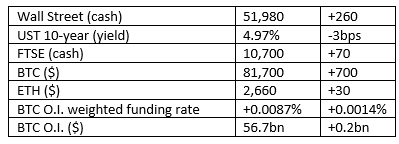
Market Wrap
There was a brief breach of $82k to the upside in May, but we must go back to January to see a sustained period above that level. As we move into the time zone that has traditionally marked the key turning point of the four-year cycle (hint: upwards) I become ever more confident that we have seen the lows of this cycle at $58k at the start of July.
I note also that BTC dominance is beginning to turn down. I am not sure that we will see a repeat of the broad-based alt frenzy of the past – there are just too many of them, and too many retail investors have previously been burnt. However, the window for quality alts (we all have our own list) to outperform for the next two years or so looks as if it is being slowly cranked open.
Curious Cryptos’ Commentary – Crypto adoption
The EU’s world-leading crypto regulation, MiCA (Markets in Crypto-Assets), creates a regulatory platform for crypto businesses that is transparent, fair, and reliable. Firms wishing to undertake regulated crypto activity within the EU apply for authorisation under MiCA with any of the twenty-seven countries’ national regulators. Once approved, and registration is granted by ESMA, that registration is passported to the other twenty-six countries, plus the three EEA states, allowing the firm to operate anywhere within the EU. If you want more information on the nitty-gritty, ESMA has oft-updated, handy guide here.
In just three months from June to September, the number of TradFi firms on the register has doubled to eighty from about forty. These firms now make up nearly a quarter of the register. Just last week, Deutsche Bank filed to launch institutional custody for BTC, ETH, and some stablecoins, in response to client demand.
Here is an interesting point that I had not realised before.
TradFi firms – specifically credit institutions and MiFID investment firms – have a much shorter route into providing regulated crypto services – they need only provide information to their regulator forty working days before starting the service. This gives TradFi a huge competitive advantage over disruptors. Rarely has the value of the regulatory moat to the incumbents, at our cost, been on such obvious display.
…
The CCC has long been a vocal critic of Binance and its lackadaisical attitude towards financial regulation under its previous CEO, man-child Changpeng Zhao, who preferred the moniker CZ for reasons that escape any rational human being. He was convicted in November 2023 of “failing to maintain an effective anti-money-laundering (AML) programme at Binance” in violation of the Bank Secrecy Act. He personally paid a $50mm fine, whilst Binance was hit with a further $4.3bn.
Trump hasn’t always shown good judgement. True to form, he pardoned Zhao in October 2025, again for reasons that escape any rational human being. At least the forfeited cash was kept by the US government.
Since Zhao, as part of his sentence, was forced to step down from any executive role at Binance, the firm has shown great willingness to adhere to legal and regulatory norms. A fish always rots from the head, they say. I am sure it takes a while to change the culture of the place, but solid progress is on display. That can only be a good thing for the crypto industry at large.
Binance applied for a MiCA licence in Greece. Officials there informed ESMA in early June that they were minded to approve the application. Press conferences had apparently been arranged, with photo shoots with senior Greek officials in the company of Binance CEO Richard Ten. If that had come to pass, the benefits of teaching senior management at Binance the strict rules required to maintain registration within the EU would flow through to all its other global operations.
In mid-June, mere weeks later, reports surfaced that the application was to be rejected, and so Binance withdrew it. It has stated it will try again with a different EU regulator.
Last Friday, the Wall Street Journal (not a crypto-supporting publication by any means) reported that “Christine Lagarde Helped Block Binance’s Foothold in Europe”.
I am not sure why WSJ didn’t use her full title i.e. Convicted Criminal Christine Lagarde, but I guess the editor was having an off-day.
I must admit, in my personal pantheon of villains, Binance rates more favourably than Lagarde. But the idea that senior EU officials deign to get involved in the autonomous decisions of a national regulator must surely send shivers down everyone’s spine.
…
Why does this matter?
With respect to Lagarde, another public display of her unsuitability for public service isn’t going to move the dial one jot. Somehow, some people just get away with it.
As for TradFi moving into the regulated crypto space, well, there is only reason for that. Clients, both retail and institutional, of those banks are hammering down the doors for crypto services.
For retail, committed investors will find their own ways. Those who wish to dabble on the sidelines probably don’t want to go through the process of setting up new accounts at, say, Coinbase and undoubtedly don’t want to get involved with self-custody. On that note, I suspect in just a few years’ time the role of self-custody in cryptos will have morphed into an interesting niche, but a niche all the same. What will the feral scumbag fraudsters do with their misspent time then? With a fair wind, North Korea will finally go bankrupt.
The more that TradFi offers crypto services to retail via recognised banking apps with ease of execution, and, more importantly, secure custody, the more mainstream crypto becomes.
Just one of the many routes that will normalise cryptos as an investment for the masses, to everyone’s benefit.