
tl;dr
JPM about-turns again on its crypto-sceptic stance. MS pushes further with its crypto-supportive stance. Another exchange goes down.
Market Snap
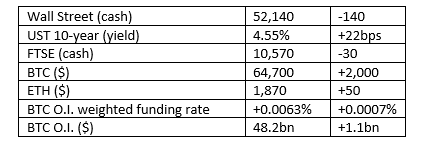
Market Wrap
Four consecutive days of net inflows into the spot BTC ETFs is maybe, just maybe, an indication that the final capitulation of this crypto winter is behind us. If so, the timing is in line with the four-year cycle, raising the possibility of some interesting times for the remainder of the year.
Curious Cryptos’ Commentary – J.P. Morgan (JPM)
JPM’s CEO and Chairman, Jamie Dimon, has been an arch crypto-sceptic for all time, certainly in public:
“I’m a major skeptic on crypto tokens, which you call currency, like Bitcoin. They are decentralized Ponzi schemes.”
JPM launched its own private and permissioned blockchain named Onyx as an upgrade to a traditional database, but as regular readers are all too keenly aware by now, many of the benefits that accrue from blockchain technology require the blockchain to be public and permissionless.
Finally recognising the truth of that, the bank has launched an on-chain money market fund on Ethereum. The fund invests in Treasury bills, bonds, and overnight repos, assets that are held in custody. Clients of JPM, who have undergone all the required KYC and AML checks, deposit funds into the vault, which acts like a traditional fund but with one huge advantage. Settlement, dividend payments, and redemptions are all handled automatically by the smart contract running the vault. The tedious and expensive business of reconciliation is removed at a stroke, increasing investors’ returns.
Launched in May, NAV has grown to around $685mm, which is not too shabby in anyone’s book.
Perhaps, one day, Dimon will concede he is wrong about cryptos.
…
The growth of tokenisation is real. A year ago, there were virtually no stocks onchain. Less than two months ago there was $1bn. Today there are $2bn. That is exponential growth and nothing will stop it.
Curious Cryptos’ Commentary – Morgan Stanley (MS)
Unlike JPM, MS as a firm has long been supportive of cryptos, moving quickly to allow its clients to buy crypto ETFs shortly after launch, and creating its own BTC ETF.
Its internal investment platform for clients, E*Trade, has been extended to include BTC, ETH, and SOL:
https://www.morganstanley.com/press-releases/etrade-completes-crypto-spot-trading-rollout
For investors, the process of buying cryptos is the same as that for buying stocks, with the trades and custody farmed out to Zero Hash. There are none of the issues around seed phrases and private keys that are often the target of feral scumbag fraudsters. The crypto holdings are viewed alongside stocks and other investments, allowing for efficient portfolio management. Later this year, MS will introduce transfer functionality, both into and out of E*Trade.
Chad Turner, Head of Morgan Stanley Wealth Management Platforms, explains:
“It’s an exciting time for E*TRADE clients with all we are delivering to enhance our product offering and turbocharge the client experience. With the rollout of crypto trading on E*TRADE we’re advancing our digital assets strategy and bringing new capabilities to clients in an integrated way.”
MS has total client assets of $7-8 TRILLION. Only a portion of this is routed through E*Trade but the direction of travel is clear – one day all MS clients will have a secure, simple, and fast means of investing in the top cryptos in a totally secure environment.
That product offering will bring a new wave of investment money into the crypto space, probably mostly BTC.
Curious Cryptos’ Commentary – Knaken
A cautionary tale for you, and one you have heard before.
Knaken is – or rather, was – a centralised cryptocurrency exchange based in Holland. It seems unlikely to me that its name wasn’t chosen specifically to encourage confusion with a much larger, and longer-established exchange, Kraken.
Knaken has been declared bankrupt after halting operations in June. The authorities believe approximately EUR 7mm of client funds are missing. There is no information on the total amount of deposits, but we know that there were about 30,000 retail clients, some of whom had tens of thousands of euros of cryptos deposited on Knaken.
I feel sorry for those who have lost some of their investments, but I’ve got to ask this question again – why would anyone use any exchange outside of Coinbase, Binance, and KuCoin?