
tl;dr
Perhaps unwittingly, the Bank of England has made public the possibility that despite the enthusiasm of Convicted Criminal Christine Lagarde, the Euro CBDC might be jettisoned, and not a day too soon.
Market Snap
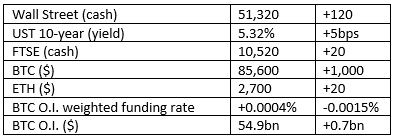
Market Wrap
Futures are increasingly pricing out the prospect of interest rate rises in the US for the last quarter of 2026, but that isn’t helping the long end of the yield curve. BTC has twice tried to breach $87k to the upside in the last few days. I don’t think many will be surprised when we see a nine-handle once again.
Curious Cryptos’ Commentary – “Future of Money”
The Bank of England held a conference last Thursday titled the “Future of Money”. The opening remarks were delivered by hopeless and hapless Andrew Bailey, Governor of the Bank of England, whose major contribution to the financial markets was a dramatic increase in the headcount of pen-pushing bureaucrats at the UK regulator, the FCA, whilst also overseeing a precipitous drop in the quality and quantity of work at that organisation. On the upside, I guess we can rest easy that if he were put in a job that had real impact on the world, we really would be in trouble.
The London School of Economics was a joint organiser of the conference. We can be in no doubt about the groupthink at the LSE with regards to cryptos.
Nonetheless, the blurb accompanying the announcement of the conference showed willingness to engage in a debate about the impact the crypto revolution will have on finance:
“Today’s monetary system may well be at the brink of major change driven by technological innovation that enhance (sic) the scope of digital money and expand the set of assets acceptable as payments. At the same time, there have been structural changes in financial intermediation, with non-bank financial institutions playing a larger role in global financial markets.”
That last line refers more to the rise of shadow banking, a phenomenon engineered by the likes of Bailey and his ilk to move as much risk as possible out of the regulated banking sphere and into the unregulated world so that it becomes someone else’s problem. Increasingly, cryptos are taking on that role.
The rise of stablecoins merited a whole session to itself with the presentation of two academic papers:
https://www.bankofengland.co.uk/-/media/boe/files/events/2026/october/hofmann.pdf
https://www.bankofengland.co.uk/-/media/boe/files/events/2026/october/ferrari-minesso.pdf
The first of these makes one very interesting observation, that cuts through the groupthink of the LSE. It makes the obvious point that the growth of regulated stablecoins under the GENIUS Act will lead to increased holdings of short-term US government debt by the stablecoin issuers, lowering government borrowing costs. This we know already, but it extrapolates from that to saying this allows the government to spend more or to cut taxes. With the US deficit predicted to be 6.2% of GDP for 2026, the real problem is surely the spending, not the financing. This is a rather more pressing problem that academics at the LSE flatly refuse to acknowledge.
The second paper adds little more of any value to us.
…
ECB Executive Board Member Isabel Schnabel used her appearance on the panel that closed the conference to outline the ECB’s approach to, and thinking on, how it can launch its own tool for oppression and control, a euro-denominated central bank digital currency (CBDC).
I am sure none of us can ever forget the horror we felt when seeing Convicted Criminal Christine Lagarde announcing the next stage of the development of the euro CBDC – “Off we go to the digital Euro” – as if she was telling primary schoolchildren that they were going to be taken to the park for the afternoon. A word of warning, if you have not yet seen this video, your life will be immeasurably improved by not clicking on the link:
In a welcome outbreak of sense, Schnabel set out three options for a euro CBDC, the third of which has clearly been informed by the GENIUS Act:
Issue central bank reserves directly as tokens on a programmable platform.
Link the existing central bank settlement system to DLT platforms.
Let private intermediaries issue tokens fully backed by reserves held off-chain.
The prospect of lowering interest costs on government debt accrued because of the fiscal incontinence demonstrated by all Western countries (with the honourable exception of Norway) might turn out to be our defence against CBDCs. Now that would be an amazingly positive result, one that will have Lagarde flouncing off to be head of the UN sooner rather than later.
…
Why does this matter?
Only if you set store by the concepts of freedom, liberty, and privacy.