
tl;dr
Germany loses its advantage. The US is making some good progress. The UK, as ever crypto-wise, will likely take the wrong turn.
Market Snap
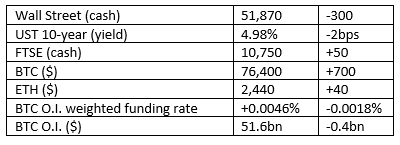
Market Wrap
Spot BTC ETFs have seen net outflows for the last week or more, losing $1.1bn in the last seven days, a sharp reversal of the change in sentiment at the beginning of the month. I am surprised at just how speculative ETF flows are proving to be – which I do not like.
Curious Cryptos’ Commentary – Crypto taxes
Up to now, Germany has been one of the most enlightened destinations for those with crypto assets. The current rule is that any cryptos held for longer than twelve months are entirely free of taxes if sold after that.
Shocking, I know. If only that applied to all assets across all countries, there is little doubt that productivity would dramatically improve due to a game-changing boost that benefits everyone.
But alas, that is not to be. The German Federal Ministry of Finance has reportedly proposed that from 1st January 2027, gains from holding cryptos will be subject to the standard 25% flat-rate tax as from the beginning of 2028. I note, however, that this new rule will not be backdated to assets acquired before 1st January 2027, which is absolutely the right thing to do, a topic to which we shall return another day.
…
The US is also proposing changes to its crypto tax regime. The House Ways and Means Committee published a new 114-page tax bill.
This aims to put confusion about crypto taxes to bed. In a break from our standard editorial policy, I think that Perplexity probably does a better job than I at summarising the key elements of a 114-page dense legal document than I could ever hope (or have the time) for:
“H.R. 10357 — Digital Asset Tax Certainty Act (~200 words)
Introduced 14 September 2026 by Ways and Means Chairman Jason Smith, this bill overhauls the tax treatment of digital assets across seven titles.
Title I eases everyday use: no gain or loss on de minimis network or transaction fees under $10; an elective simplified annual mark-to-market style calculation for "widely traded" assets (defined as market cap above $500m, from 2028); and stablecoin transactions valued at redemption value rather than tracked as property, from 2027.
Title II brings parity with securities — lending nonrecognition, dealer and trader mark-to-market elections, an extended non-US trading safe harbour, and relief from appraisal requirements for charitable gifts.
Title III applies anti-abuse rules: wash sales and constructive sales now capture digital assets (effective from introduction), plus subpart F/PFIC, straddle, possessions-sourcing and worthlessness rules.
Title IV sources mining and staking income by residence and confirms it is ordinary income; it also protects trust status for staking investment trusts.
Title V narrows broker reporting, orders a Digital Asset Voluntary Disclosure Programme within 12 months (penalties from 0% to 50% depending on certification and timing), and requires a Treasury study on zero-knowledge proofs and smart-contract withholding by September 2028.
Title VII restores full deductibility of wagering losses against winnings.”
Source: Perplexity/Opus 5 dated 17/09/2026.
The “de minimis” rule in Title I is interesting.
Here in the UK, gas fees are officially seen by the rapacious taxman as the sale of cryptos for a benefit and therefore is a taxable event. What this means in practice is that you as a crypto holder must continually recalculate the weighted average acquisition cost every time you make a transfer of cryptos. Anyone who self-custodies, stakes their own coins, is involved in DeFi, or any crypto activity, is suddenly faced with an ever more complex tax return to the benefit of literally no-one. Sceptics might argue this attitude by the authorities in the UK is simply another arm of ChokePoint 2.0. I could not possibly comment.
But I have a practical solution, which has worked so far for me. Every year, in my tax return, I state boldly upfront the assumptions I have made in my calculation of gains and losses. One of those assumptions is that cryptos to pay gas fees are always sold at zero. That immediately gets over the problem identified above, has no material impact on my tax liability, and has not been challenged in over five years by HMRC. It might want to do that later, but it is hard for them to justify doing so with the consistent full disclosure I have shared over the years. Note, this has not been formally recognised by HMRC and certainly should not be taken as tax advice.
I know, I know. You are thinking I am foolishly expecting to be treated by HMRC in a rational and fair manner, which rarely, if ever, happens. You do have a point. We shall see.
Staking in Title IV is another bone of contention with HMRC.
Guidance says that nearly all staking rewards are subject to income tax. However, when you look at HMRC’s requirements for staking rewards to be subject to income tax, I have yet to find a PoS coin that satisfies those requirements. Again, the complexity of treating staking rewards as subject to income tax would be an attractive tool to supporters of ChokePoint 2.0 who wish to suppress a perfectly legal activity.
My approach with HMRC is to state explicitly that I do not consider any of the staking rewards that I have received to be subject to income tax, just capital gains tax when sold with an acquisition price of zero. After five years or more, there has been no pushback from HMRC. I consider the matter settled, though others might not.
…
Here in the UK, it is a widely held expectation that CGT rates are to increase at the next budget later this year.
Internal Government modelling suggests that doing so leads to ever-decreasing amounts of tax raised, turning negative at rates not much higher than where we are today. Obviously, that is just modelling, but it is self-apparent that increasing taxes on any activity results in less of that activity. For a country that suffers from a productivity and growth problem (we are hardly unique in that respect, I grant you), to deliberately raise the cost of capital for businesses appears to me to be self-defeating.
I understand that there are few people who would shed a tear at the idea that crypto investors get to keep less of their gains. But the implications of increasing CGT go much further than that, to everyone’s detriment.