
tl;dr
A gentle introduction to bond maths to get your weekend properly started.
Market Snap
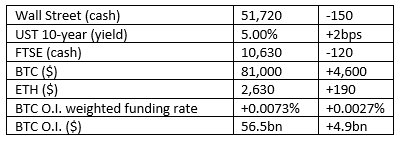
Market Wrap
Be afraid, be very afraid:
“Do I want to go in and annihilate them [the Iranian regime] or do I not? … Anything could happen with me.”
I think you know who. The second sentence certainly resonates. Resumption of full-scale hostilities could never be a good backdrop for risk assets.
Occasional Series – Spring 2031
Assuming AI hasn’t killed us all by then.

Curious Cryptos’ Commentary – Bring it on!
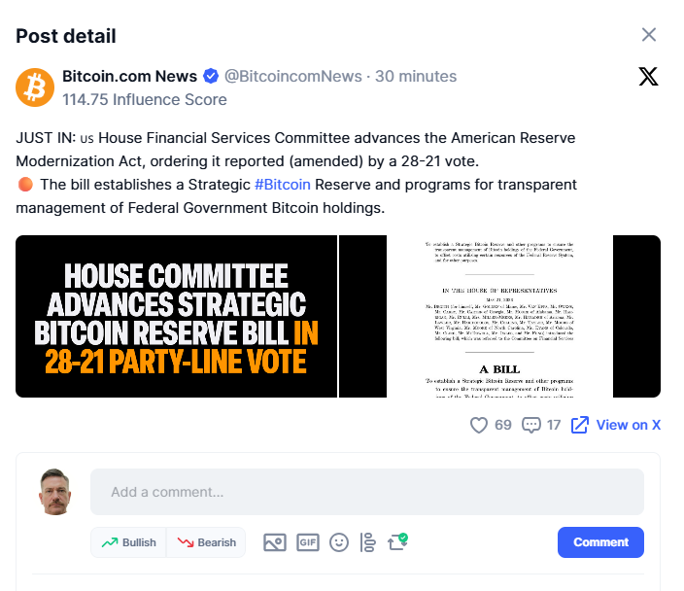
Curious Cryptos’ Commentary – Bond markets and the return of QE
Following the recent spate of manipulation of the short end of the yield curve higher by most central banks, the accompanying statements have led James Athey, a fund manager at Marlborough, to make this terrifying claim:
“What central banks have achieved this week is to near-explicitly tie their policy outlook to the oil price. So, what we are increasingly seeing is yields following the oil price.”
It’s annoying I must repeat this, but an increase in the price of oil acts much like a tax increase – you get less economic activity, though it doesn’t show up for 18-30 months. An increase in rates achieves the same end – less economic activity in 18-30 months’ time. Adding a recessionary rate increase, which bears no impact on the price of oil, to the recessionary impact due to an increase in oil prices is simply doubling down on reducing the size of the economy over the course of the next couple of years.
These rate rises will be reversed soon enough, but only after they have wrought as much damage as possible to everyone’s lives.
Long-end yields above 5% are not sustainable for Western governments, who are all running annual deficits even during the good times, and whose debt pile becomes ever harder to sustain.
There are two ways to get long-end yields down. The hard way is to balance the books, perhaps even to run a surplus as we saw during Bill Clinton’s time as president. The easy way is to manipulate the long-end with QE.
Which is exactly the direction that the UK has just agreed, though the news might have passed you by. To understand more, we must take a journey into the recent past.
…
In response to the immoral and illegal restrictions put upon us by the politicians in response to Covid, an agreement was made between the government and the Bank of England to embark upon wholesale quantitative easing via the purchase of newly issued government bonds by the Bank of England from the Treasury.
QE is itself an immoral and maybe illegal (almost certainly in the EU) policy decision, for it inflates the value of hard assets, whilst also inflating the value of commodities in closed economies, which is exactly what the shutting down of the economy achieved. Making the rich richer, and the poor poorer, should not be a deliberate policy decision, but that is exactly what the powers-that-were decided to do.
The QE framework was initially agreed in 2009 between Mervyn King as Governor and Alistair Darling as Chancellor. The mechanics of it – which we shall shortly come to – are so badly designed it is very clear that neither had even the most basic understanding of bond maths. Subsequent Governors, Mark Carney and the hapless Andrew Bailey, demonstrate the same shortcoming, as do all the other Chancellors, including Rishi Sunak and Jeremy “not my real surname but this is a family friendly publication” Hunt. It is disgraceful that those who make such momentous decisions do not grasp the interaction between yields and bond prices. It is enough to make one despair.
…
If a country goes down the QE route there is only one sensible means of doing so. The bonds bought by the central bank go into a separate pot, which recycles the interest and notional repayment back to the government. In effect, there is no cost to the public purse of servicing the debt. It’s not called money-printing for nothing.
The very worst way of setting up the process is exactly what the UK decided to do.
During QE, yields are pushed close to zero. Bonds newly issued by the Government are bought by the central bank with low coupons.
The agreement between the UK government and the Bank of England is that once QE had passed, the Bank of England would start selling that stockpile of bonds. But here’s the thing – once QE has ended long rates go much higher. Moving 10-year rates from 0% to 5% reduces the value of 10-year bonds by nearly 50% (Dv01 multiplied by the change in yield in bps). The Bank of England has been furiously selling 10-year bonds bought at par at prices up to nearly 50% lower. Known as QT (quantitative tightening) this leads to losses for the Bank of England, losses that are reimbursed by the UK taxpayer, a position unique to the UK for no good reason whatsoever.
In its assessment of August 2026, the Bank of England estimated its total losses from QT at £120bn, losses that need never have occurred. That’s an extra £120bn of debt or tax increases that are totally unnecessary, simply because senior members of the government and of the central bank do not understand bond maths.
…
In a rare outbreak of sanity, new Chancellor John Healey has pointed out to the hapless Bailey that these losses need not be incurred. With a bit of arm-twisting (Bailey doesn’t like it when situations change, his bureaucratic mindset does not take kindly to it) the QT program has been substantially altered:
i) Gilts maturing before 2035 will not be sold. They simply run off as the government repays them.
ii) Gilts maturing from 2035 to 2049 are intended for disposal at about £20bn a year but sales are paused until April next year. I doubt it will restart.
iii) The longest-dated gilts, including those maturing after 2049, will no longer be sold.
This news led to an immediate rally of the long-end. It is the precursor to an announcement (in my opinion) that there will be small, selective new purchases of long-end debt in the market. This again will suppress yields.
We can firmly expect other governments to follow shortly.
This is the reason why cryptos have been rallying for the last couple of days. BTC will be one of the biggest beneficiaries of this additional monetary liquidity.