
tl;dr
Spot BTC ETFs are looking healthy, and so is the UK, crypto‑wise.
Market Snap
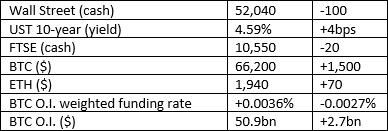
Market Wrap
There have now been five consecutive days of inflows into the spot BTC ETFs, totalling around $720mm. There is well-documented correlation between the change in the price of BTC to ETF flows, but much of the better research is paywalled so I cannot share the details. Suffice to say, that the setup is probably the best we have seen since we last breached $100k to the downside in November 2025.
There are results due from Alphabet, Tesla, and Intel this week, which might make for some interesting reading. Next week brings another Fed meeting, and another chance for rate markets to begin to comprehend that they have got it all wrong.
Curious Cryptos’ Commentary – The UK
The UK goes from strength to strength, crypto-wise at least.
Recent developments include a regulatory framework for cryptos, detailed rules for issuing regulatory-approved stablecoins, the registration of Coinbase under MiFID, the establishment of a pilot programme to prove the benefits of tokenisation (spoiler alert: it’s all upside). More encouragingly, there has been radio silence on the prospects of Britcoin, the UK’s mooted tool of oppression and control, a sterling CBDC.
All of this should have been happening for years. The UK has foregone so much tax revenue largely due to the antagonism towards cryptos exhibited by Rishi Sunak (he who industrialised the concept of giving everyone oodles of free cash to be paid for by future generations) and the hapless and hopeless Andrew Bailey. Bailey’s crypto stance has been publicly undercut by the new stablecoin regime, so a period of reflection on his part would be welcome.
Now, the UK’s Crypto and Digital Assets All-Party Parliamentary Group (APPG) has launched an investigation into the illegal and immoral Operation Choke Point 2.0’s UK operations. APPG co-chair Lord Vaizey of Didcot is not happy:
“Over a number of years, the APPG has heard consistent reports from crypto and digital asset businesses that they face difficulties accessing bank accounts and banking services, alongside concerns about restrictions on crypto-related transactions by banks.”
He also points out the blindingly obvious, which unfortunately some people seem to miss:
“Access to banking services is fundamental for any legitimate business, and where unnecessary barriers exist, they have the potential to hinder growth, investment and innovation.”
It has been notoriously difficult for crypto firms to open bank accounts in the UK. There has been systematic debanking of firms and individuals with crypto links. Anyone who has tried to transfer regular or one-off sums of money to legitimate centralised cryptocurrency exchanges, including the publicly listed Coinbase Inc., knows that it is a process potentially fraught with difficulties. The only UK bank I know that is supportive of cryptos is Revolut, though I concede there may be others.
This idea that banks are allowed to restrict our access to legitimate activities is scarily dystopian. Let’s hope that the resulting report from APPG will put this matter to rest. If so, the UK’s crypto journey is really getting started, to the benefit of us all.
…
We also cannot ignore the fact that we now have a new Prime Minister, Andy Burnham..
Andy’s crypto credentials are sound (https://www.curiouscryptos.com/andy-burnhams-crypto-promise-and-the-cabinet-that-could-undermine-it/) though probably not well-developed at this stage. Despite many of his colleagues being on-record with anti-crypto statements, the CCC remains upbeat about his elevation to his new job.
One of his first acts has been to scrap the UK’s digital identity scheme which is a relief to libertarians countrywide. We all know the government cannot accurately – and, more importantly, securely –maintain a database of each of our identities. Feral scammers in Russia, North Korea, and China are sorely disappointed at this news.
Stefan Deiss, co-founder and CEO of The Hashgraph Group, has a suggestion that Andy should mull over:
"The technology has moved on, and there's now a better way: credentials held in a secure wallet on the citizen's own phone, not on a state server.”
He means the blockchain, natch.