
tl;dr
Simple advice – ignore this hard fork unless we tell you otherwise. If you want to know why, read on.
Market Snap
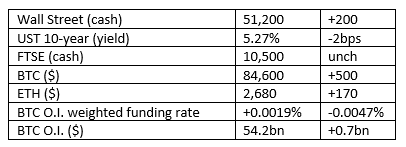
Market Wrap
A weak jobs report drove BTC briefly above $87k until a sharp reversal bounced off $84k. That non-farm payroll number, which came in at+29k compared with an expected +84k, dampened expectations of another interest rate rise but I must caution you that the methodology behind that number has very shaky foundations. I have never understood why so many people put so much store in it.
Curious Cryptos’ Commentary – A brief explanation and history of hard forks
A hard fork occurs when new blockchain code has been released alongside the original. A copy of the history of the blockchain forms the basis of both chains. Owners of coins on the original chain will have the same holdings on the new chain too. Some have likened this to the creation of free money, but that isn’t really the case as we shall see.
Both chains live or die depending on the level of post hard-fork support they get from the miners in the case of PoW coins, or from the validators for PoS coins.
During 2017 there was a plethora of hard forks for BTC, most of which have withered away. The first one, known at the time as BTC Cash (BCH) continues today. It has a market capitalisation of $6bn, less than 10% of its peak reached a few months after the hard fork.
There were plenty of others. Bitcoin Gold (BTG), Bitcoin Diamond (BCD), Bitcoin God (GOD), BTC Interest (BCI), Super Bitcoin (SBTC), and Bitcoin Atom (BCA) spring to mind. These were all hard forks that were reasonably easy to interact with, and were legitimate projects at the time, though none survive today.
Ethereum has famously been subject to two contentious hard forks which resulted in rival chains. The first rectified the blockchain history following the exploit of the very first decentralised autonomous organisation, DAO. The prospect of effectively rewriting history was shocking to some, and so a group of miners (ETH was a PoW coin at the time) kept the original history for a new coin called Ethereum Classic (ETC). With a market cap of $1.4bn compared to the ETH market cap of $330bn, it seems clear to me that maxis have not garnered popular support for their cause.
The second ETH hard fork occurred when ETH moved from PoW to PoS. Some objected to that move in principle and kept the PoW chain going. Ethereum PoW (ETHW) has a market cap of $31mm and some activity, though I suspect its long-term future is already determined.
Other coins have also experienced hard forks. NEM (XEM) split into NEM and Symbol (XYM), a blockchain that seems to have a cult-like support in some countries in the Far East.
…
The history of hard forks tells one very compelling message.
They are not very successful.
There is also plenty of scope for fraud, or user error when interacting with the new coin. The standard advice is to steer well clear. Naturally, I have never done that, for I cannot leave it alone. If you are going to try to realise additional value from hard forks there is only one sensible option – once you have successfully retrieved your new coins, sell them as quickly as possible, and invest the proceeds back into the mother coin.
Oh, and another mistake many people make. Never buy a coin simply because of a forthcoming hard fork. A lot of folks do that, artificially inflating the price, which will then rapidly deflate post hard fork. Simple analysis shows that a better strategy would likely be to sell in advance of a hard fork, to buy back later. That was certainly the case when Ethereum moved from PoW to PoS.
Curious Cryptos’ Commentary – A new Bitcoin hard fork
Party like it’s 2017 all over again.
On or near October 31st, at BTC block 973,728, a hard fork of the BTC blockchain is planned.
If you own 1 BTC in your Ledger-managed wallet (and frankly, who doesn’t by now?), you will own an equivalent amount of the new coin, ECX (eCash) on the new chain. Lovely, free money, and all that. What could possibly go wrong?
Well, an awful lot to be fair. I repeat my advice above - your best option is to ignore the new chain altogether, at least for the time being. Having said that, do as I say, not as I do.
…
The first point is that there is already a coin known as eCash, XEC. You have got to wonder why anyone would deliberately muddy the waters by using the same name. That is not normal behaviour for a legitimate project and is an immediate red flag for me.
A risk common to many hard forks is that of a lack of replay protection. Perhaps a simple example will suffice for explanation. If, after the fork, you downloaded an ECX wallet and transferred your ECX holdings to another wallet, or to a centralised cryptocurrency exchange, that same transaction might also be broadcast on the BTC blockchain. If so, that could be a major problem for you, potentially resulting in loss of your BTC. Hard forks have never been worth more than the mother coin, and usually a lot less, so in this scenario you would be left ruing your involvement.
Moving your BTC first seems to me the obvious solution, though the eCash website recommends moving ECX first:
“The integration guide’s operator procedure splits the ECX side first: it sends pre-fork outputs to fresh ECX addresses using protected transactions, waits for deep ECX confirmations, and only then resumes independent BTC operations. A reorganisation that reverses a split can expose the outputs to replay again.”
Call me a sceptic if you like, but not in a million years would I follow that advice.
There will also be fake ECX wallets circulated by the feral scammers in the employ of Russia and North Korea. I fear innocent BTC investors will put their personal stash at risk by failing to use the official wallet, which itself cannot be guaranteed to be reliable.
I also read that half of the ECX coins equivalent to the Satoshi stash will be reassigned, presumably to the developers of ECX. At 2.5% or so of the total supply, this sounds odd and wrong to me, another red flag.
…
Why does this matter?
It shouldn’t matter, for everyone should simply ignore this hard fork unless and until it is proven to be a real project, with real value. If that happens, we might revisit this topic.
Meanwhile, please do not be tempted by the prospect of what might look like free cash. It is just too risky at this stage.